For Part 1, click here.
By John Adams, Syon Abbey Research Associates and joint author, The Syon Abbey Herbal
John’s full length article about the Herbal is available as a PDF to download here.
Culture: Women’s Health
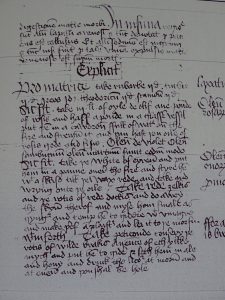
Women’s health in the mediaeval period has been a growing area of academic research, and there a number of excellent studies of this area, for example,
Green, M. H. ed., (2011). The Trotula: an English translation of the medieval compendium of women’s medicine. Philadelphia: University of Pennsylvania Press.
It does not seem that the Syon Abbey had a copy of The Trotula, written by a female physician (Trota) in Salerno in the 12th century. But there were 15 copies in other libraries in England. This leads to another useful search tool – the catalogue of the Mediaeval Libraries of Great Britain. This lists in great detail the contents of the libraries of 599 convents and monasteries and universities, at: http://mlgb3.bodleian.ox.ac.uk/authortitle/medieval_catalogues/
A simple search under the word ‘herbarum’ (of herbs) throws up 41 examples in various libraries in Britain; ‘Dioscorides’ has 30 records. This methodology allows one to decide if the text in question was rare, or in common use.
Uroscopy
Urine was particularly important for medicine in this period. Betson has a whole chapter (in Latin) on the use of urine for diagnosis, particularly of women’s conditions. It is called de Urinalibus (‘on urine flasks’). He draws on two widely circulating texts of the early Middle Ages: Urina Rufa (Reddish Urine) and Colamentum Sanguinis (Cleansing of the Blood). These two texts originated in a 12th-century uroscopy treatise that has been called by German scholars, ‘Der kurze Harntraktat’ (The Short Treatise on Urine). The text was mistakenly attributed to Johannes Vitalis (d.1327) in both the manuscript (1300s) and printed version (1531) of his Pro conservanda vitae.
The diagnosis of disease and prognosis of its course by the examination of urine was one of the basic tests introduced to the west by the Salerno School of Medicine. In particular the de Urinis of Maurus of Salerno (c.1130-1214) was one of the major works to which physicians of the 12th and 13th century referred. It was present in at least three monastic houses in Britain but appears to be absent from the Syon library catalogue.
Syon had however around twenty other titles on uroscopy, with most of the classic texts. These included a copy of Theophilus (fl. ? 7th century) de Urinis. This was a common text, recorded in at least a dozen British houses or colleges according to the British Library (BL) Corpus. Theophilus served as a source of Giles de Corbeil’s poem of the same name, de Urinis, also present at Syon. This too was a popular work – 15 recorded copies in Britain. The commentary by Gilbertus Anglicus on Corbeil’s de Urinis was also at Syon, one of five copies recorded in Britain. There was also a copy of the Liber urinarum by Isaac Iudaeus, translated by Constantinus Africanus, printed at Lyon in 1515. This title was used in the Paris medical course. Finally, Syon had the sole recorded copy in Britain of Walter Agilon’s Compendium urinarum. For further coverage see The Syon Abbey Herbal, pp. 59-60.
Urine was also used in the diagnosis of Malaria – still endemic then in Britain. In the Harntraktat text cited by Betson,there is the chilling comment ‘Urina Nigra: In quartarna semper est mortalis et mala’ – ‘Black Urine: in quartan fever (malaria) it is always fatal and evil.’
Occasionally urine found its way into remedies – including one for poor eyesight. Details of these manuscripts and texts are given in The Syon Abbey Herbal (2015).
Last Gifts: Star of Bethlehem Ornithogalum umbellatum
After giving us the Herbal, Syon had one more gift for us. In 1549, a decade after the Dissolution of Syon Abbey, Somerset, Protector to King Edward VI, moved into Syon House with his herbalist physician, William Turner, known as the father of English Botany. Turner conducted and published what is probably the sole audit of the remains of an English monastic garden. (Details are in Turner, W. (1538 & 1548/1965). Libellus de Re Herbaria & The names of herbs. London: Ray Society (Reprint). Also in our PDF of the Syon Abbey Herbal.)
We passed this to the current Head Gardener at Syon and were also able to compare it with a similar mid-Victorian audit. Star of Bethlehem, which had perhaps guided us in our quest, was, he told us, still growing there nearly 500 years later, ‘in profusion on the ha-ha.’ Ha ha, indeed. It might be hard to cite any similar continuity in Britain.
Bibliography
The following publication gives a comprehensive bibliography with details of the Herbal MSS and more detail on the Syon Abbey Herbal. John has kindly allowed us to post this as a PDF alongside the blog.
Adams, J. S. (2015). Syon Abbey: Its Herbal, Medical Books and Care of the Sick: Healthcare in a Mixed Mediaeval Monastery.
Also available on request from: j.s.adams@amcd.co.uk
Adams, J.S. and Forbes, S. (2015). The Syon Abbey Herbal AD 1517. London: AMCD (Publishers): London.
Adams, J.S. (May 2020). A Bibliography of Syon Abbey, Isleworth, with Some Sources for the Early History of Syon House.
Adams, J.S. (2013-2020). A List of Extant Printed Books and Manuscripts from Syon Abbey with their Current Location & Printed Books by, or Attributed to, Syon Authors, with a Short Bibliography.
Forbes, S. and Adams, J. S. (2020). The 1539 Syon Abbey Dissolution Inventories: TNA LR 2/112 & TNA E 117/11/58 with BODLEIAN MS Add. E. 3 (R): Transcriptions and Commentary.
Note from the Editor. Readers will note that both spellings of the word, “mediaeval” and “medieval” appear in this blog. The first with “ae” from the author and the second without the “a” in book and link titles. The history behind the difference is interesting. The word Mediaeval appears first in 1817, having evolved from the Latin medium aevum and referring to the Middle Ages as this period had previously been known. Perhaps in deference to the growing use of the typewriter which did not have a key for æ the new spelling of medieval first appeared in 1876. Either spelling has been used since then with a growing prevalence of medieval, however the choice remains a matter of preference.