Claire Burridge
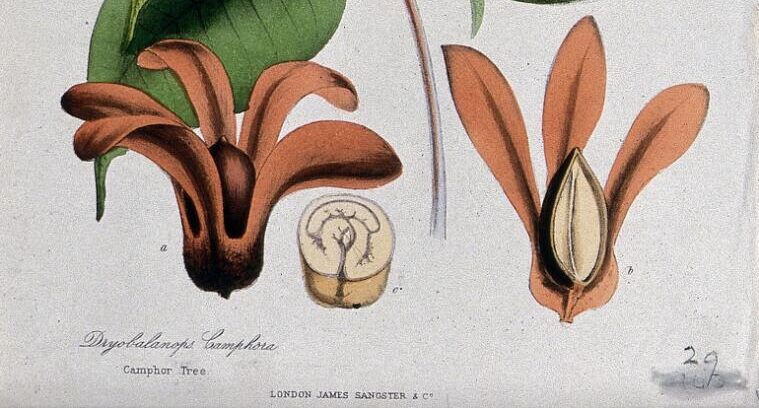
Incense may seem a surprising topic for the Herbal History Research Network (HHRN) blog for several reasons. First, whether you’re familiar with incense as sticks, grains, and/or oils that release fragrant smoke when burned, such products may appear to be far removed from the herbal substances typically discussed in these posts, such as Siobhán Barrett’s piece on medieval Irish remedies or Cassandra Quave’s post on the connections between food and medicine. Yet the ingredients used to produce incense were – and are – largely plant-based materials, such as resins and fragrant woods that fit the HHRN’s herbal focus. Camphor, pictured in Figure 1, for example, is often recorded as an ingredient in early medieval incense recipes (Burridge, 2020).
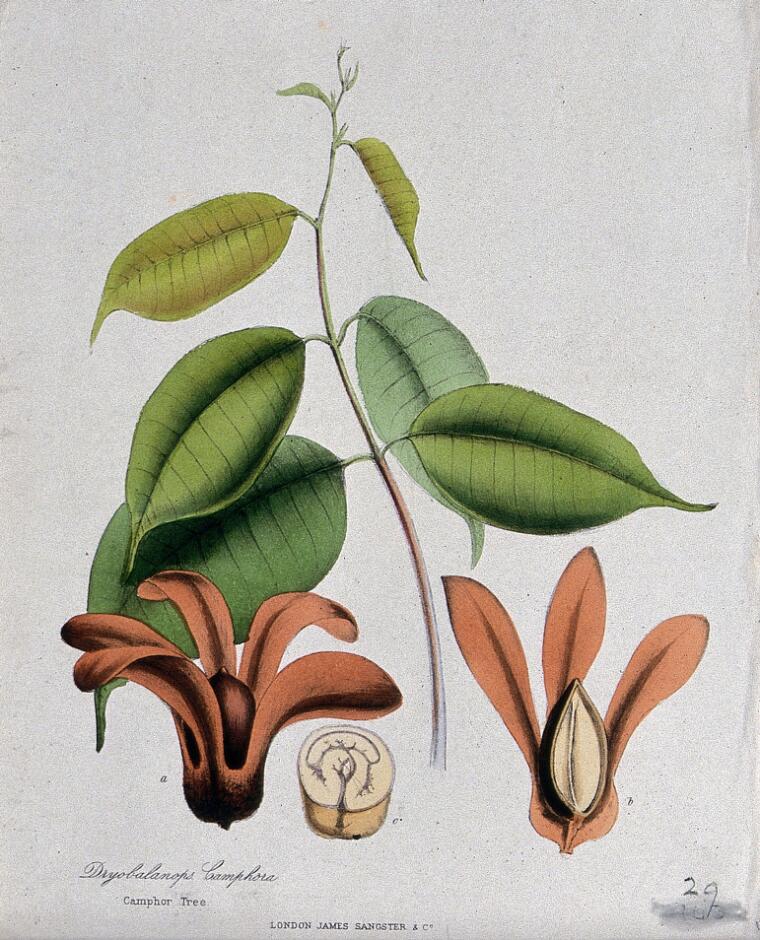
Secondly, since the use of incense today is generally associated with spiritual settings, such as in churches and temples, its application in medical contexts might be unexpected. The multipurpose nature of incense, however, has a long and global history (see Figure 2 for a scene of incense production from ancient Egypt). Indeed, incense’s religious and medical functions are reported in a number of classical and late antique pharmaceutical texts, such as Dioscorides’ De materia medica, a pharmacopoeia that addresses the medical applications of hundreds of vegetable, animal, and mineral substances. In this text, a type of incense known as cyphi is described as ‘an incense preparation that pleases the gods; the priests in Egypt use it lavishly. It is also mixed with antidotes and it is given to asthmatics in drinks’ (Dioscorides/Beck, 2005, pp.22-23).
Although incense is absent from western medical practices today – recent work has instead highlighted the potentially detrimental effects of incense smoke (Cannistraro et al., 2019; Polednik, 2013) – this aromatic product continued to be associated with medicine in the early Middle Ages: it appears as an ingredient in a number of medical recipes from this period.
A treatment for epilepsy recorded in a collection of recipes in the ninth-century Latin manuscript BAV reg. lat. 1143, for example, lists timiama among its twenty-four ingredients (see f. 109r for the recipe in question, Ad cadiuo homine potionem probatam). This Latinised Greek term is a synonym for incensum, incense (Isidore of Seville/Barney, Lewis, Beach, et al., 2006). The other products included in this recipe range from potentially local herbs, such as agrimony, betony, and savory, to non-local spices, resins, and roots, including cinnamon, myrrh, and ginger.
As noted above, recipes for incense (as opposed to medical recipes that incorporate incense as an ingredient) tend to combine resins and fragrant woods; early medieval incense recipes also often contain spices and other aromatic substances (Burridge, 2020). Ingredients that appear with some frequency include frankincense, myrrh, storax, mastic, camphor, agarwood, cloves, and cassia/cinnamon. Intriguingly, among the non-local ingredients listed in the recipe from BAV reg. lat. 1143, we can find several of these individual ingredients, too. Why include frankincense, myrrh, cinnamon, cloves, and cassia and incense (timiama) if the latter represents a blend of (at least some of) these very products? Wouldn’t this be somewhat redundant?
First, let’s consider spice mixes, such as garam masala, ras el hanout, and herbes de Provence. Each one of these spice mixes provides pre-prepared blends of several different spices and herbs. If, say, you were making a curry that called for garam masala – a mix that often includes roasted and ground fennel, bay leaves, peppercorns, cloves, cinnamon or cassia, mace, cardamom, cumin, coriander seeds, and red chili powder – would you think twice if the recipe also called for adding bay leaves, pepper, or coriander? Probably not.
I give this simple example just to illustrate that pre-prepared, composite ingredients tend to a) bear no immediate resemblance to their individual constituent parts (e.g., compare garam masala with a bay leaf or incense grains with cassia bark), and b) offer something distinctive to a recipe given the way they have been prepared (roasted, ground, and combined). In other words, whether we’re thinking about early medieval incense or the jar of garam masala in your kitchen, such composite ingredients do not merely duplicate individual ingredients that might also appear in a recipe. While a modern parallel might help us to think about the practical side of preparing a recipe, it’s essential to consider early medieval medical texts in the environment in which they were written. Significantly, the surviving early medieval manuscripts that contain medical recipes appear to have been produced, by and large, in monastic writing centres (Glaze, 1999). Given this context, it seems unlikely that scribes recording recipes with ingredients closely linked to liturgical practices did so without any sense of their Christian symbolism (Burridge, 2022). So, was incense included in recipes precisely because it was perceived as imbuing a treatment with a higher power?
While this could be possible, it is important to remember the medical framework in which such a symbolic ingredient was being used. Not only can each of the constituent parts of incense be found as ingredients in medical recipes in their own right, but the use of incense in medicine was part of a long tradition, as illustrated by Dioscorides’ comments on cyphi. It seems likely that the appearance of incense in early medieval recipes was linked to all these factors, though individual scribes may have been more influenced by certain factors than others.
Ultimately, given the herbal products used to produce incense, the long history of its varied uses, and the monastic settings in which both medical and incense recipes were recorded, incense offers an exciting topic to explore further and provides promising directions for future research.
References
Burridge, C., (2022). Healing Body and Soul in Early Medieval Europe: Medical Remedies with Christian Elements. Studies in Church History, 58, pp. 46-67. https://doi.org/10.1017/stc.2022.3.
Burridge, C., (2020). Incense in medicine: an early medieval perspective. Early Medieval Europe, 28, pp. 219-55. https://doi.org/10.1111/emed.12394.
Cannistraro, M., Cannistraro, G., and Restivo, R., (2019). Environmental monitoring of sacred artworks – A case study for the search for an index of correlation between particle concentration and mass of fine dust. Thermal Science and Engineering Progress, 14. https://doi.org/10.1016/j.tsep.2019.100405.
Dioscorides (2005). De materia medica. Ed. and trans. L.Y. Beck. Hildesheim: Olms-Weidmann.
Glaze, F.E., (1999). The perforated wall: the ownership and circulation of medical books in medieval Europe, ca. 800-1200. Unpublished Ph.D. thesis, Duke University.
Isidore of Seville (2006). The Etymologies of Isidore of Seville. Trans. S.A. Barney, W.J. Lewis, J.A. Beach, et al. Cambridge: Cambridge University Press.
Polednik, B., (2013). Particle exposure in a Baroque church during Sunday Masses. Environmental Research, 126, pp. 215-20. https://doi.org/10.1016/j.envres.2013.07.009.
Additional resources
Donkin, R.A., (1999). Dragon’s Brain Perfume: An historical geography of camphor. Leiden: Brill.
Everett, N., (2018). The manuscript evidence for pharmacy in the Early Middle Ages. In: E. Screen and C. West eds. Writing the History of the Early Medieval West. Cambridge: Cambridge University Press. pp. 115–30.
Everett, N., (2012). The Alphabet of Galen: Pharmacy from Antiquity to the Middle Ages. Toronto: University of Toronto Press.
Opsomer, C., (1989). Index de la pharmacopée du Ier au Xe siècle. 2 vols. Hildesheim: Olms-Weidmann.
Thurlkill, M., (2016). Sacred scents in early Christianity and Islam. Lanham: Lexington Books.
Biography
Claire Burridge holds a Leverhulme Trust Early Career Fellowship at the University of Sheffield. You can find out more about her current project, ‘Crossroads: The Evolution of Early Medieval Medicine in Global and Local Contexts’, on the project’s website.