
Written by Graeme Tobyn
Beyond the PhD a historian’s work continues. I hoped to be able to create four papers from my thesis English herbs for English bodies: The promotion of native plant remedies 1548-1659, Nicholas Culpeper and his antecedents (Tobyn, 2017).
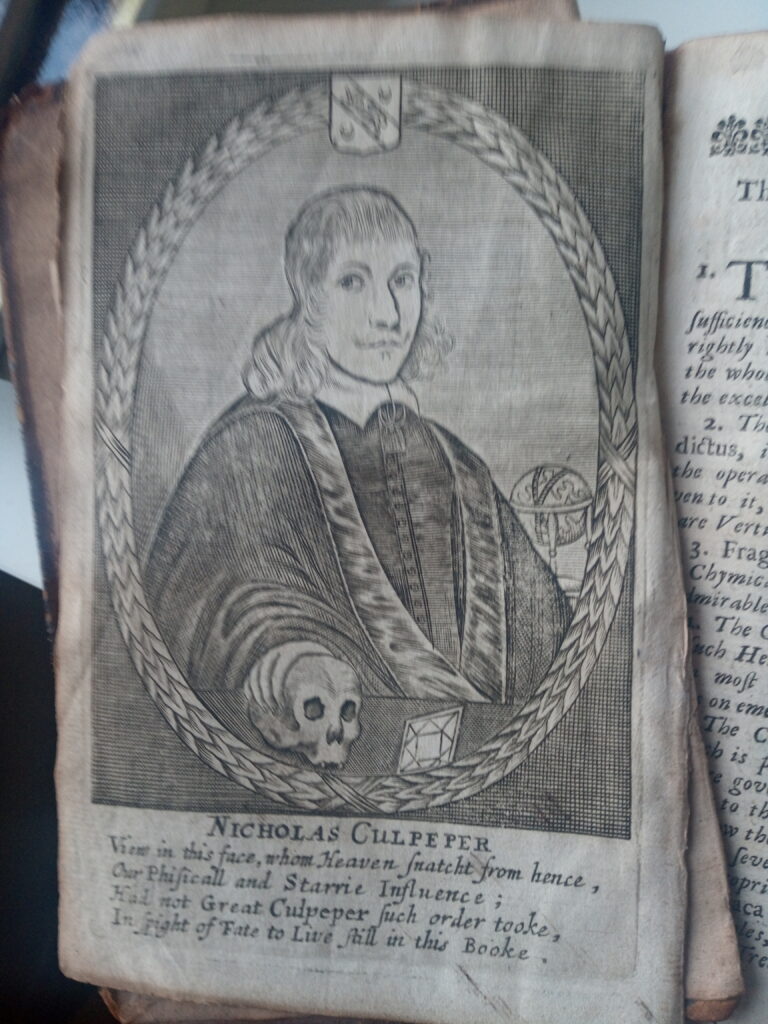
The first could complete my study identifying that most medical information in Culpeper’s herbal (Figure 1) is from apothecary John Parkinson, a preliminary review of which was published several years ago (Tobyn, 2014). The second could use material on plague remedies. But the historical literature on the plague is vast and the focus in my thesis was tiny: whether the sixteenth-century prescriptions designated affordable by the poor in the Advice on the treatment of plague from the College of Physicians of London, were obtainable by those not ‘on the parish’ (Orders, thought meete, 1578). The third could consider the small section on Culpeper’s astrology, characterised by Patrick Curry as an ‘extreme neo-Platonic…form of English astrology’ (Curry, 1989, p.25). The fourth could examine the claim that several historians considered Culpeper was to some degree a follower of Paracelsus.
The idea for the first paper I had published, on Turner’s neologism herbary (= herbalist) (Tobyn, 2018), was triggered by that single word in the title page of Dr William Turner’s A new herbal of 1551 and the coincidence in time between Turner’s first use in 1548 and Henry VIII’s Act of 1542/3 giving rights to treat certain diseases to those ‘having knowledge and experience of the nature of herbes, rotes [roots], and waters’ (Furnivall & Furnivall, 1888).
Two factors were crucial in the production of the paper: being guided to highly relevant sources on botany and lexicography in Quadrifolia: The William Turner Newsletter and a related small study by its lead historian Marie Addyman (2017). As significant was how I organised the contents using post-its and a board. I wrote the central idea of each paragraph on a post-it, stuck them on a board and re-arranged them until I felt I had the best line of narrative.
Both the chapter on planetary assignations and the article on Turner’s herbalists were produced quickly for special publications drawing on the conference presentations.
The former was actually a complete re-writing of an earlier submission not deemed of sufficient standard but which was saved by turning the focus onto Culpeper’s stated sources in his principal astrological text (Culpeper, 1651; Tobyn, 2015). I realised I got on well with a tight focus and circumscribed historical area for research.
I did find a way of using my plague material in a paper comparing and contrasting how the government of Elizabeth I tried to manage epidemics nationally with how Boris Johnson’s government was managing the Covid pandemic (Tobyn, 2021). Much was very similar! I wrote this over a ‘fevered’ month in the first lockdown as an adult experiencing the phenomenon for the first time – there was no-one alive in 2020 from the previous one in 1919-20! – but using my historical knowledge of early modern epidemics.
In 2018, I presented at the British Society for the History of Pharmacy conference on the preparation of spirits and distilled waters described in the Pharmacopoeia Londinensis. Culpeper commented extensively on this section in his translation, especially that of the 2nd Latin edition (Culpeper, 1653).
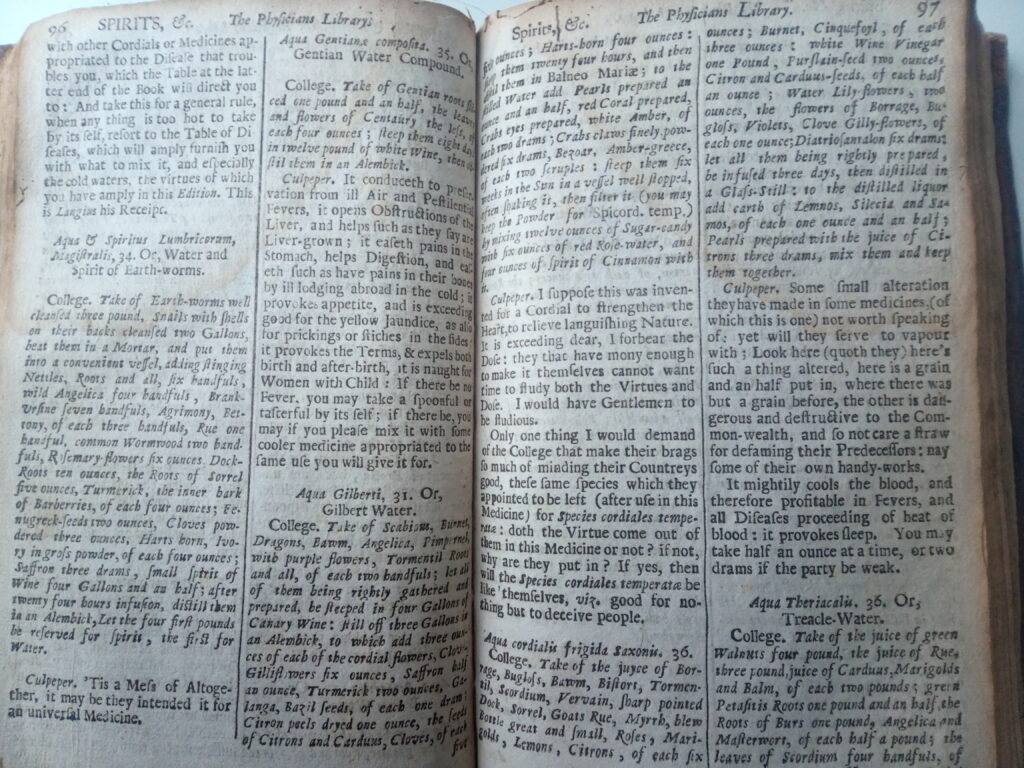
Contrast the directions for making medicines in his own herbal, which featured ‘Galen’s’ rather smelly, cold distillation using pewter stills rather than the Paracelsian distillation by fire (Culpeper, 1652) see Figure 2. The equipment for the latter was prohibitively expensive and might only be found at the College of Physicians’ new laboratory, among ‘chymical’ experimenters, to use a term coined by Newman and Principe (1995) to denote the seventeenth-century mix of alchemy and early chemistry, but still looking to all the world like alchemy in Culpeper’s day; and soon enough in the still-rooms of forward-thinking, well-to-do ladies in the country (Cook, 1986). For whom, I asked, were each of these Culpeper texts written and what do they tell us about his knowledge of chymistry? The coming into focus, sometimes serendipitously, of the research question emerging from the gathered sources is a satisfying as well as a necessary stage in the writing process.
That study has now expanded, however, into an evaluation of the whole of Culpeper’s translation of the Pharmacopoeia – as Christopher Hill remarked, ‘Culpeper is eminently quotable’ (1974, p.171) – and my writing continues haltingly.
As for the Culpeper/Parkinson study, it too is not yet complete. I am exploring The English civil war (2007) in search of the battle where Culpeper was wounded. When it’s author Diane Purkiss, was asked what she might be if she weren’t a writer, she suggested a village baker: “Baking is not unlike writing; it’s all about patience and honesty”. Mine are nearly ready to come out of the oven.
References
Addyman, M. (2017). William and Peter Turner: A family of English Renaissance physicians. The Friends of William Turner.
Cook, H. J. (1986). The decline of the old medical regime in Stuart London. Cornell University Press.
Culpeper, N. (1651). Semeiotica Uranica: Or an astrological judgment of diseases from the first decumbiture of the sick. Peter Cole.
Culpeper, N. (1652). The English physitian: Or an astrologo-physical discourse of the vulgar herbs of this nation. Peter Cole. https://wellcomecollection.org/works/qmg2uf64
Culpeper, N. (1653). Pharmacopoeia Londinensis: Or the London dispensatory, further adorned by the studies and collections of the fellows, now living of the said Colledg. Peter Cole. https://collections.nlm.nih.gov/bookviewer?PID=nlm:nlmuid-2751057R-bk (edition of 1665).
Curry, P. (1989). Prophecy and power: Astrology in early modern England. Polity Press.
Furnivall, F. J. & Furnivall, P. (Eds.). (1888). The anatomie of the body of man by Thomas Vicary. N. Trubner & Co.
Hill, C. (1974). Change and continuity in seventeenth-century England. Weidenfeld and Nicolson.
Orders, thought meete by her Maiestie, and her priuie Councell, to be executed throughout the counties of this realme, in such townes, villages, and other places, as are, or may be hereafter infected with the plague, for the stay of further increase of the same. Also an advise set downe upon her Maiesties expresse commaundement, by the best learned in physicke within this Realme, containing good rules and easie medicines, without charge to the meaner sort of people, as well for the preservation of her good subiects from the plague before infection, as for the curing and ordering of them after they shal be infected (1578). Christopher Barker, Printer to the Queenes most excellent maiestie. https://wellcomecollection.org/works/c3h938yb
Newman, W. R., & Principe, L. M. (1998). Alchemy vs. chemistry: The etymological origins of a historiographic mistake. Early Science and Medicine, 3, 32-65.
Purkiss, D. (2007). The English civil war: A people’s history. Harper Perennial.
Tobyn, G. (2014). An anatomy of The English physitian. In S. Francia & A. Stobart (Eds.) Critical approaches to the history of Western herbal medicine (pp. 87-103). Bloomsbury.
Tobyn, G. (2015). Dr. Reason and Dr. Experience: Culpeper’s assignation of planetary rulers in The English physitian. In C. Burnett & D. Greenbaum (Eds.), From Masha’allah to Kepler: Theory and practice in medieval and renaissance astrology (pp. 473-90). Sophia Centre Press. http://clok.uclan.ac.uk/40746/
Tobyn, G. (2017). English herbs for English bodies: The promotion of native plant remedies 1548-1659, Nicholas Culpeper and his antecedents (unpublished doctoral dissertation). Lancaster University.
Tobyn, G. (2018). Herbaries and apothecaries: The identification of William Turner’s herbalists in Elizabethan and Stuart England. Vesalius, 24(1), 67-75. https://scholar.google.com/scholar?cluster=7016664361559981070&hl=en&as_sdt=0,5
Tobyn, G. (2021). How England first managed a national infection crisis: Implementation of the Plague Orders of 1578 compared with COVID-19 lockdown March to May 2020. Social Sciences and Humanities Open, 3(1), 100111. https://www.sciencedirect.com/science/article/pii/S2590291121000073?via%3Dihub
Biography
Dr Graeme Tobyn is a Senior Lecturer in the School of Community Health & Midwifery at the University of Central Lancashire where he is Course Leader for the MSc Integrated Healthcare. His publications include Culpeper’s medicine: A practice of Western holistic medicine (1997/2013) and The Western herbal tradition: 2000 years of medicinal plant knowledge (2011/2015) with Alison Denham and Dr Midge Whitelegg.