by Anne Van Arsdall, PhD
[Author’s note: How the history of medicine, pharmacy, and herbalism became separate is complex—a modern phenomenon. Ours is a world requiring precise and well-defined categories for everything. For that reason, Old English medicine as we read it in its own words may not seem to be ‘medicine’ at all as we understand the term. But then, what should the all-encompassing healing practice of that time be called? Medicinal plants and natural substances have been an integral part of healing practices since recorded time, and much of the medical practice in antiquity and the early Middle Ages was what would today be called herbalism. Prayer, incantation, and other spiritual practices were an integral part of it. So was surgery. From time to time, so was theory. Historical circumstances such as wars, famines, migrations, abundance, affected both needs and practice. For these and many other reasons, the texts belonging to human medicine, understood broadly, are challenging, demanding understanding using both mind and soul.
A caveat here: almost all scholarship on Old English medicine goes back, if only indirectly, to the works mentioned here. However, they are a small part of a large number of Latin (and Greek) medical texts present in England at that same time. The Latin texts are only now being collected, transcribed, translated, and studied. It will be years until they are as well known as those cited here, and the picture of medicine in early-medieval England may well change considerably because of it.)]
Early-medieval England (ca 500-1066) was unusual in the western world in that a number of medical texts were written there in its vernacular, Old English. That earliest form of English, sometimes called Anglo Saxon, was entirely Germanic, for the most part. It remained that way until the Norman Conquest in 1066, when French slowly but inexorably changed it into the wonderful mixture used now. As the English language changed, most of the manuscripts written in the older form were relegated to back shelves or simply disappeared without a trace. Centuries then passed. Finally, in the 18th and 19th centuries, interest in the origin of language kindled investigations into older forms of modern languages, and a handful of philologists and antiquarians resurrected the manuscripts in Old English. They created grammar books and dictionaries, and transcriptions of the Old English led to translations of texts, perhaps the most famous today being the Beowulf poem.
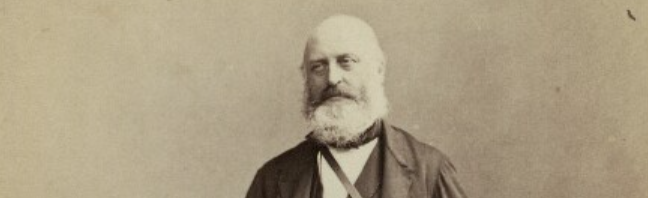
One of these men, while working six days a week as a teacher of Latin and Greek at King’s College School, resurrected, transcribed, and translated all the known works relating to medicine from Old English into a rather flowery form of Victorian English (see Figure 1).
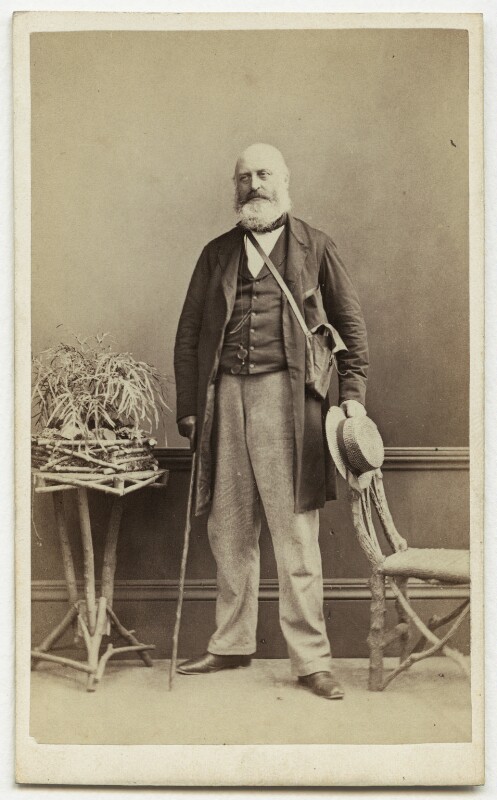
Oswald Cockayne’s Leechdoms, Wortcunning and Starcraft of Early England, Being an account of science in this country before the Norman Conquest appeared sequentially as three thick volumes between 1863 and 1865. Gathered together under this curious title were three major medical works and miscellaneous shorter pieces related to healing. In volume 1 is the Old English Herbarium, a translation of a popular Latin herbal circulating widely in the late-antique and early-medieval West. It lists 185 medicinal plants, together with information about how they grow and the conditions with which they help. Cockayne titled volume 2 Lacnunga, the Old English word for remedies. Indeed, it is a text with remedies, incantations, prayers, charms and advice in both Old English and Latin. In addition, Cockayne added here several shorter pieces related to healing. Volume 3 has what Cockayne titled Bald’s Leechbook; Bald is thought to have been a healer, and the word leech here is from the Old English word for “to heal”: thus a book of healing practices and medications. It has three parts.
These three volumes are enlightening to read just as Cockayne published them, and Google Books provides easy access: in Google Books, search on Cockayne Leechdoms Wortcunning and all three volumes will be there to read in their entirety. The miscellaneous short pieces he includes with the three major works, his notes in the margins and as footnotes, and his prefatory remarks, long as they are, together mirror the medicine of early England through the lens of its 19th century viewer. This was how early medieval medicine was first presented to Anglophone readers as part of the Rolls Series, a project approved by the British government to educate readers of national history (see Figure 2).
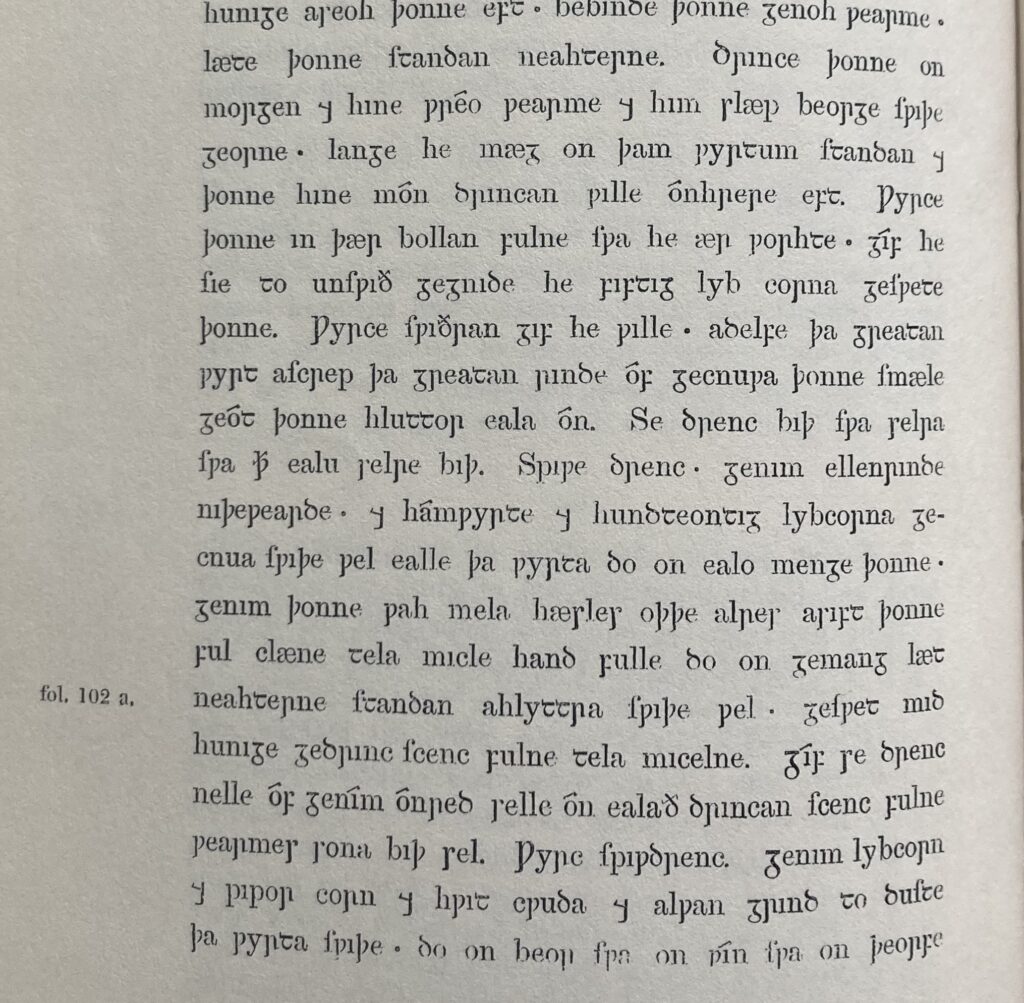
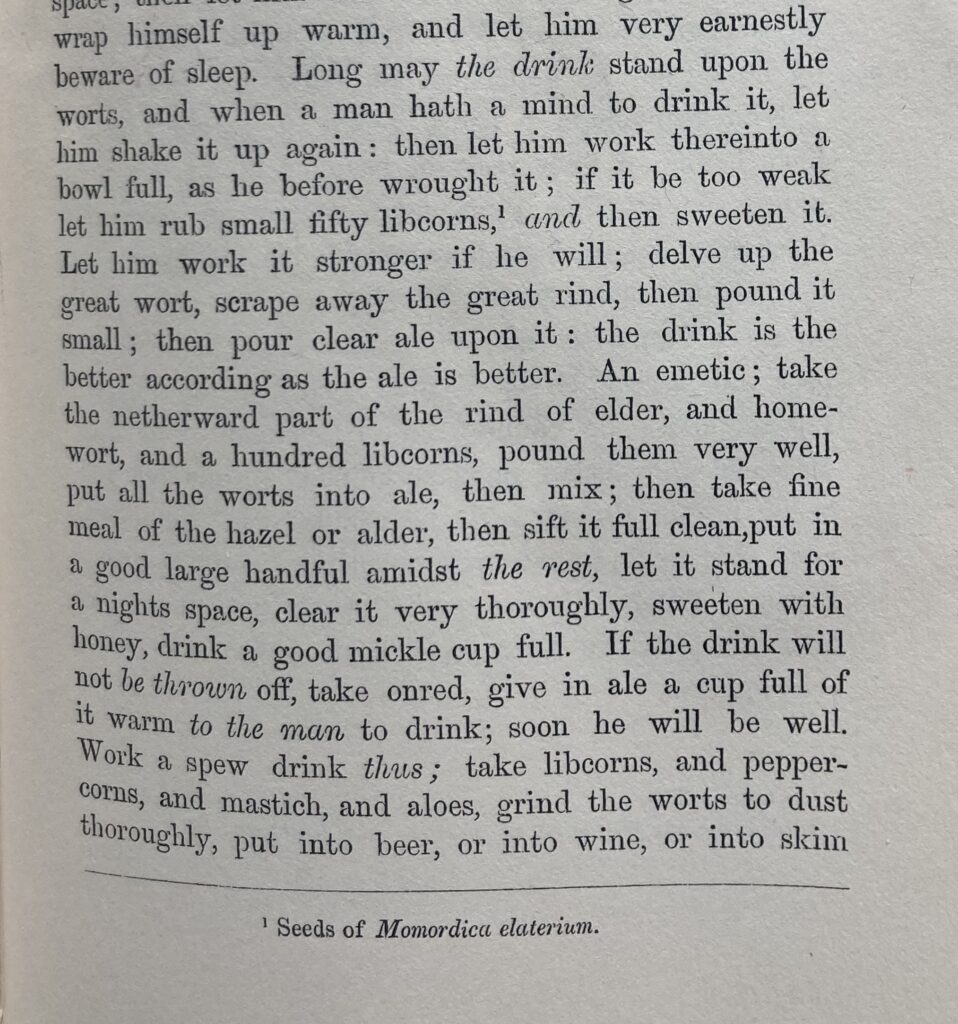
Figure 2 The font the Rolls Series used in printing Old English was specially made to replicate Cockayne’s laborious hand copied transcriptions of three fairly long manuscripts. Note their distinctive forms for “th” “r” and for other letters and abbreviations. This example is an excerpt from Leechbook II, Chapter lii (Vol II pp. 270-271), which gives recipes for a number of emetics. Cockayne’s translations of the texts are placed on right-hand pages opposite the Old English originals on the left. His unfortunate decision to translate Old English mon as ‘a man’ followed by the pronoun ‘he’ suggests most remedies are for men. More faithful to the original meaning would have been ‘one’ or ‘a person’. One example of his striving to give his translation an archaic style is seen here in his routine use of ‘wort’ for plant (i.e, the Old English word for it). As time passes and language changes, his translations are becoming even less comprehensible to most readers than they were in 1865.
Cockayne’s Leechdoms have been the basis for much written about medicine in Anglo-Saxon England since 1865. Until recently, their content has not been considered to be proper medicine, pharmacy, or herbalism, nor studied as such; although certain “extra-medical” elements like charms and incantations have been lifted out and studied in depth, particularly anything considered native and/or pre-Christian.
Most of the longer works are now available in modern translations (see citations below), and as the subject of specialist and non-specialist studies. The medicine in them has just begun to be evaluated reasonably objectively. However, this has certainly not long been the case. Until around the 1970s, the medical texts in Old English were written about and interpreted almost exclusively as part of Dark Age Medicine; i.e., worthless, ridiculous, full of superstition and magic. Many of the remarks link directly to Cockayne. Such prejudice abounds in popular depictions of medieval medicine generally, and persists today in some scholarship.
To grapple first-hand with the ‘medicine’—writ large—of the early medieval world not only in England but in Europe, some time reading Cockayne’s Leechdoms will be well spent. Modern translations tend to present one work and concentrate on providing correct meaning as we believe it to be: they help elucidate Cockayne’s deliberately archaic style, which is sometimes hard to understand. However they naturally omit his asides and additions and comments, some of which are valuable, useful, and never found elsewhere. He consulted sources no longer used, talked to then experts of whom we have never heard, he knew Latin well and could understand the underpinnings of the Old English texts that were translations, as well as nuances of some of the Old English our new dictionaries have missed. In a word, the Leechdoms itself is a valuable resource for “Anglo-Saxon” medicine, giving its practices verbatim, accompanied by discernable prejudice toward them. It most certainly belongs on the list of texts for the history of herbalism.
Modern translations of works in the Leechdoms:
Van Arsdall, A., (2023). Medieval Herbal Remedies: The Old English Herbarium and Early-Medieval Medicine. London: Routledge. Scholarly translation and study of the work and medieval medicine, with bibliography.
Banham, D and Voth, C., are preparing a scholarly edition and translation of all three parts of Bald’s Leechbooks as part of the Dumbarton Oaks Medieval Library, Cambridge, MA: Harvard University Press. Forthcoming.
Niles, J. and D’Aronco, M.A., eds., (2023). The Old English Herbal, Lacnunga, and Other Texts. Dumbarton Oaks Medieval Library. Cambridge, MA: Harvard University Press. Scholarly edition and translation with notes and bibliography.
Pettit, E., (2001). The Lacnunga: Anglo-Saxon Remedies, Charms, and Prayers from British Library Harley 585, 2 vols. Lewiston: The Edwin Mellen Press. Scholarly translation with extensive notes, commentary, and bibliography.
Pollington, S., (2000). Leechcraft: Early English Charms, Plantlore, and Healing. Norfolk: Anglo-Saxon Books, 2000. Edition and translation of Herbarium, Lacnunga, Bald’s Leecbook III; bibliography, remarks on medieval medicine for popular audience
Biography
Anne Van Arsdall studies early-medieval medicine in Western Europe not only by reading its texts, but to the extent possible, finding ways to get at actual practice using, for example, archaeological reports, results of excavations, and material in manuscripts outside texts. An on-going collaboration with Frances Watkins at HHRN to decode the terse directions in these early remedies promises to be especially fruitful in this regard.