By Brigid Mayes, Medical Herbalist and researcher, Co. Westmeath, Ireland*
‘So we have achieved a succinct and beneficial fulfilment of this book, drawn from the Antidotaries and Herbals of the city of Salerno, according to the united studium of the doctors of Montpellier. Those masters have stated that everything that is begun in the name of God deserves to be completed in the name of God.
And that is how this book was completed by Tadhg Ó Cuinn, bachelor in physic, in the month of October, on the feast day of Saint Luke, the Apostle, and in the year of Our Lord one thousand, four hundred and fifteen, to be precise. The End, Amen.’
The words quoted above are the concluding paragraphs of Tadhg Ó Cuinn’s Materia Medica. We know nothing of Ó Cuinn’s life other than what can be gleaned from these words, and from a few other scraps of evidence. Manuscript sources indicate that he collaborated with members of two prominent families of hereditary physicians attached to chieftaincies in the province of Munster in south-west Ireland. Niocól Ó hÍceadha acted as amanuensis for his 1400 translation of a work by Geraldus de Solo, and Aonghus Ó Callanáin was his amanuensis for the Materia Medica in 1415. Ó hÍceadha and Ó Callanáin were translators in their own right: of a commentary on the Aphorisms of Hippocrates in 1403, and possibly of the Salernitan Regimen Sanitatis.
These works form a small part of the extensive corpus of medical texts in Irish dating from the beginning of the fifteenth century, adapted and translated from the Latin by physicians whose aim was to provide the basis for a full medical education in the vernacular (Nic Dhonnchadha, 2000). Physicians were among the service kindred of the Gaelic chieftaincies, and a number of them maintained schools. Formal healthcare structures had been in place in Ireland since at least the eighth century, as Old Irish medico-legal texts indicate (O’Kelly, 2000). By the time Irish physicians made their formal engagement with European learning, Graeco-Arabic texts in Latin translation were already well integrated into medical education in western Europe. Teachers in the faculty of medicine in Montpellier, where we may assume that Ó Cuinn became a bachelor in physic, were active in the process of integration, as he himself acknowledges, and as today’s scholarship confirms (Demaitre, 2013).
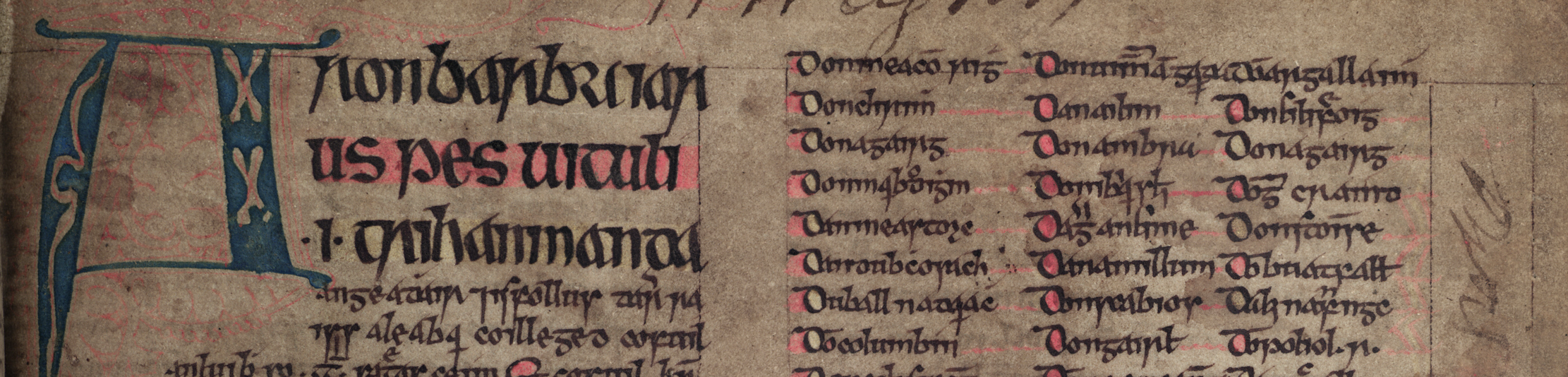
The field of medieval medicine as studied and practised by the Gaelic physicians has yet to be fully incorporated into the history of medicine in Ireland. There are various reasons for the existing lacuna, one being that the texts are written in fifteenth century Irish, accessible nowadays to only a small number of scholars. A translation into English of Ó Cuinn’s Materia Medica, made by Micheál Ó Conchubhair, was published online in 2019, in the Corpus of Electronic Texts at www.celt.ucc.ie. There are eighteen extant manuscript copies of the Materia Medica, the latest of them written in 1870. Ó Conchubhair based his translation on a copy which dates from the fifteenth century and is held in the library of Trinity College, Dublin (TCD MS 1343). This copy comprises 292 chapters, of which 238 are based on plants or plant-derived substances or products, arranged in roughly alphabetical order.
Ó Cuinn’s work is underpinned by Galenic theory. Plant chapters give the name of a plant or plant derivative, its primary qualities (dry, moist, cold, hot) and the secondary qualities or ‘virtues’ that equip it for specific therapeutic uses. In most cases, Ó Cuinn gives directions as to which part of the plant should be used and in what form to treat specific conditions; in some cases, directions for harvesting and storage; in some cases cautions and contraindications. Platearius, whose Liber de Simplici Medicinae is considered to have been the herbal of Salerno, is the author Ó Cuinn cites most often, followed by the De Viribus Herbarum of Macer Floridus. The majority of plants included in the Materia Medica are native to Ireland; introduced plants which can be cultivated in Ireland also feature. The work includes exotic spices, gums and plants deriving in the main from Arabic pharmacy and reflecting well developed trade links with the wider world.

A current in twentieth century historiography viewed the engagement of Gaelic physicians with European medicine in a somewhat negative light, as an abandonment of their old learning in favour of what was alien and unusable in practice in Ireland. Today’s view is more nuanced. To what degree the actual use of plants as advocated in the Materia Medica represented a continuity with previous practices, both lay and professional, is unknowable. It is probable that Ó Cuinn in some cases validated existing usage by placing it in a theoretical framework and making reference to authorities; it is more than likely that he put forward new applications for plants already in use, and that he introduced plant medicines previously unfamiliar in Ireland.
The publication of the Materia Medica with its English translation on www.celt.ucc.ie is most welcome. It offers an opportunity to consider overlaps between learned and vernacular medicine which have tended to be compartmentalised as separate domains. It opens a number of potential avenues of research and exploration, both historical and geographic, reaching back to the influences which shaped Ó Cuinn’s work, and forward to the influence it has had for centuries beyond the time of its composition.
Select Bibliography
Demaitre, L.E. (2013). Medieval Medicine. The Art of Healing, from Head to Toe. Santa Barbara: Praeger.
Irish Script on Screen, School of Celtic Studies, Dublin Institute for Advanced Studies. Digitised versions of medical manuscripts, including, in TCD MS 1343, the copy of the Materia Medica used by Micheál Ó Conchubhair for his 1991 translation. www.isos.dias.ie
Kelly, F. (2000). ‘Medicine and early Irish law’. In J.B.Lyons, ed. Two Thousand Years of Irish Medicine. Irish Journal of Medical Science 170/1.
Mayes, B. (2018). The Materia Medica of Tadhg Ó Cuinn (1415): an Irish and European work. Unpublished MA dissertation, University College, Dublin.
Nic Dhonnachadha, A. (2000). ‘Medical Writing in Irish 1400-1700’. In J.B.Lyons, ed., Two Thousand Years of Irish Medicine. Irish Journal of Medical Science 169/3. Available online at http://www.celt.dias.ie/gaeilge/staff/rcsi1.html
Ó Cuinn, Tadhg (1415). An Irish Materia Medica. Included is a transcript of the Irish text from TCD MS 1343, the English translation by Micheál Ó Conchubhair (1991), Ó Conchubhair’s Introduction and his compilation of Latin sources used by Ó Cuinn. https://www.ucc.ie/celt/published/G600005/index.html
Ó Murchú, L., ed. (2016). Rosa Anglica: Reassessments. London: Irish Texts Society Subsidiary Series 28.
*Author Bio:
Brigid Mayes is a medical herbalist with a practice in Co. Westmeath, Ireland. While she was doing a piece of research on the use of medicinal plants in North Westmeath as evidenced in the Irish Folklore Commission’s Schools’ Project of the 1930s, a friend mentioned the Materia Medica of Tadhg Ó Cuinn and produced some photocopied pages of Micheál Ó Conchubhair’s translation, then held in typescript in the School of Celtic Studies, Dublin Institute for Advanced Studies. This sparked a big interest, and she undertook explorations into the Materia Medica, the context in which it was written, and the place it deserves in the history of medicine in Ireland.