By Caroline Rance, Researcher at The Quack Doctor
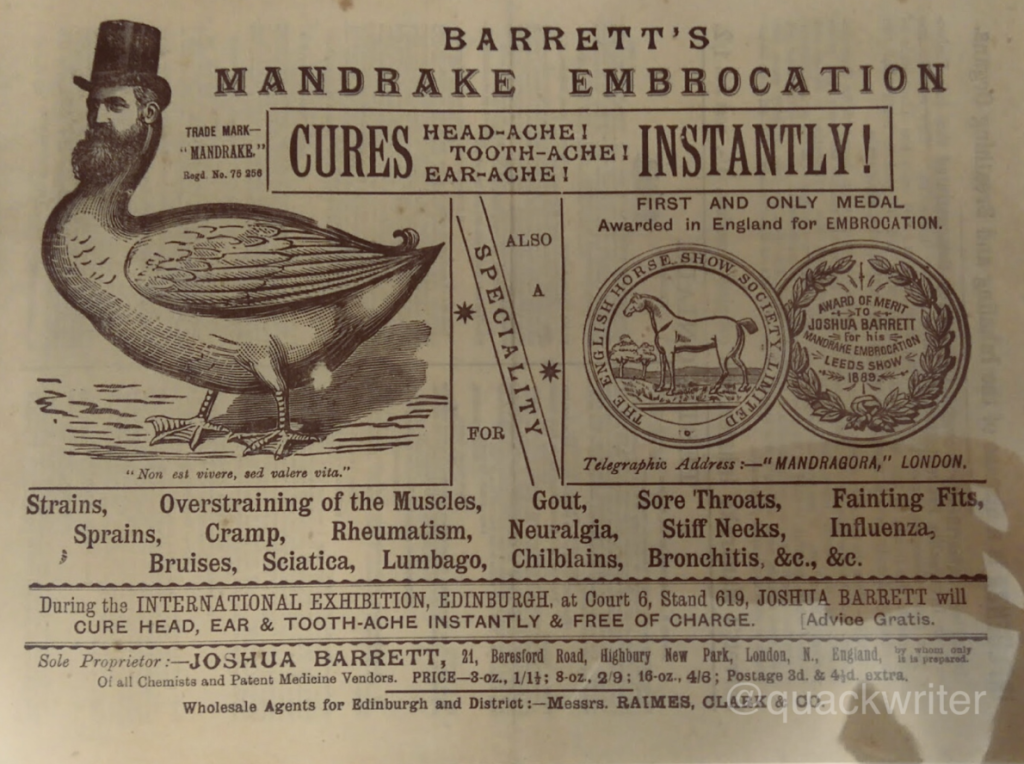
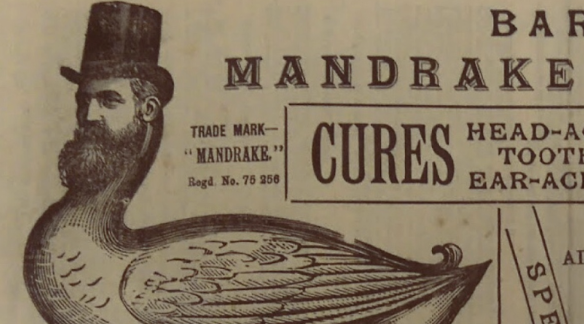
The grotesque humanoid form of the mandrake root, screaming fatally when ripped from the earth, has a long folkloric history. In Victorian and early 20th-century England, however, a self-described ‘Mandrake Specialist’ relied less on magic than on hard work, enthusiasm, and a peculiar portrait of himself with the body of a duck (Figure 1).
The activities of Joshua Barrett (1850-1931) represent a crossover between traditional herbalism and the highly commercial patent medicine market. His promotional techniques align him with the ‘quacks’ of the day, yet there is also evidence that he used genuine botanical ingredients for his medicine, and enthusiastically believed in its efficacy.
Barrett came from a respected farming family in the village of Bluntisham near St Ives, Huntingdonshire. After an early career as a textiles salesman, he moved to Islington and promoted Barrett’s Mandrake Embrocation – a liquid for rubbing into ‘sprains, bruises, overstraining of the muscles, cramp, rheumatism, sciatica, lumbago, gout, neuralgia, chilblains, mumps, ear-ache etc.’ (‘Barrett’s Mandrake Embrocation’, 1888). He travelled countrywide to agricultural fairs and town bazaars, giving out Embrocation samples and evangelising about the product’s curative powers. At an exhibition in Edinburgh in 1890, a representative of the Chemist and Druggist light-heartedly dubbed him ‘the apostle of mandrake’ (‘International Exhibition,’ 1890).
It is no surprise that Barrett extolled the virtues of his remedy at every opportunity – but he does appear to have trusted in it and had a genuine desire to help people, even when there was no prospect of a sale. At a market in Goole, Yorkshire, in 1897, a young boy was burnt by an exploding gas stove and Barrett rushed to his assistance with a bottle of Mandrake Embrocation. He applied this to the lad’s hands and face, reportedly making him comfortable before helping the poor father who had fainted (‘Accident at the Goole’, 1897) A couple of years earlier, he had been first on the scene when a man at an agricultural show got kicked in the face by a colt, and ‘his conduct and skill on this occasion were highly spoken of.’ (‘Devon County Show’, 1895).

The most striking thing about Barrett’s marketing was his registered trademark, a visual pun that showed his head, complete with top hat, attached to the body of a drake. Original and bizarre, it appeared not only on his advertisements but also as an embossed design on the Embrocation bottles. Perhaps Barrett even intended it as an ironic nod to those who might consider him a quack! In conjunction with the trademark, he used an epigram from the Roman writer Martial: ‘Non est vivere sed valere vita’, which can be translated as ‘Life is not merely living, but living in health’. Those aspiring to a healthy life learnt, of course, that it was in reach with the help of Mandrake Embrocation.
A 1908 handbill in the Bodleian Library’s John Johnson Collection refers to ‘Mandrake fields’ in Bluntisham, which gives the impression that while Barrett did the exhibition rounds, his ingredients were growing on the family farm (‘Barrett’s Mandrake Embrocation’, 1908). Later, after the sale of the farm, Barrett’s brother William rode around the county on a tricycle, collecting the roots that grew wild (‘Bluntisham and mandrake remedies,’ 1918). But although Barrett used the name of mandrake’s genus ‘Mandragora’ (Figure 2) as his telegraphic address, the variety in the Huntingdonshire soil was probably not the plant reputed to scream and cause the death of whoever dug it up.
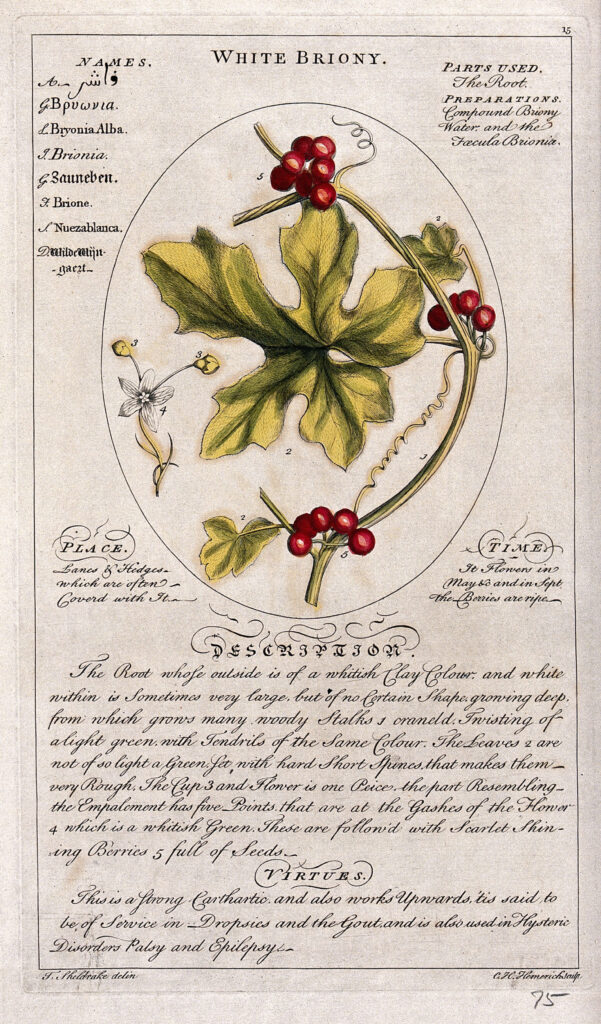
When a representative of the Gardener’s Chronicle visited the Sandy flower show in 1889, he was sceptical about the identity of the ‘large root of white colour, resembling a huge, many-branched Beet,’ that adorned Joshua Barrett’s stand. He thought it looked more like deadly nightshade (Atropa belladonna L.), although the editor weighed in with a comment that it was probably bryony (Bryonia dioica L) (Fugure 3) (‘A new cure for rheumatism,’ 1889).
Barrett himself gives us a hint that the editor was right. After the death of his brother, he placed newspaper adverts offering to pay 10s per hundredweight for freshly dug mandrake root. He specified that by ‘mandrake’ he meant white bryony (‘Wanted, At Once’, 1918).
This plant, sometimes known as the English mandrake, had a history of being passed off as Mandragora. Maud Grieve, in her Modern Herbal (1931), quotes Thomas Green’s assertion from 1832 that imposters would fix human-shaped moulds around the growing bryony roots, producing their very own ‘mandrakes’ for sale to the unsuspecting public (Grieve, 1931). We can only hope Barrett’s customers did not drink the topical Embrocation, because bryony was traditionally used as a drastic laxative.
Grieve also mentions its use for influenza, and this aspect had served Barrett well in 1889-90, when the ‘Russian flu’ pandemic reached Britain.As outbreaks raged across the globe, Barrett seized the opportunity to promote the Embrocation as a ‘Scientifically Proved and Practically Demonstrated’ cure. Sufferers had to breathe in the liquid’s fumes from a sponge, or use the special glass inhaler available from Barrett for an additional shilling ( ‘Barrett’s Mandrake Embrocation’, 1889). Bryony has an unpleasant, acrid smell – but this might have helped people believe it would do them good! Although the disease was dangerous, and caused an estimated one million deaths worldwide, most otherwise healthy people would recover after a week or two (Berche, 2022). Barrett – like many patent medicine manufacturers – could take advantage of the post hoc ergo propter hoc fallacy that led sufferers to credit the Embrocation with their survival.
Barrett is an ambiguous practitioner who reflects the broader medical landscape of the late Victorian era, where traditional herbal knowledge and the aggressive marketing of fraudulent products jostled with an increasingly scientific approach in formal medicine. Part medical showman with exaggerated claims, and part botanical enthusiast who did go to the trouble of sourcing the ingredients he believed in, he is well represented by the strange hybrid of human and drake that adorned his products.
References
‘Accident at the Goole Market Hall’, (1897, October 1). The Howdenshire Gazette.
‘A new cure for rheumatism,’ (1889, September 14). The Gardener’s Chronicle, p. 305. Available at: https://www.biodiversitylibrary.org/item/83851
‘Barrett’s Mandrake Embrocation’, (1888, August 11). The Hunts County News, p1.
‘Barrett’s Mandrake Embrocation’, (1889). Handbill, London. Patent Medicines 1 (33). The John Johnson Collection of Printed Ephemera. Bodleian Library, Oxford.
‘Barrett’s Mandrake Embrocation’, (1908) Handbill, Snaith. Patent Medicines 1 (34). The John Johnson Collection of Printed Ephemera. Bodleian Library, Oxford.
Berche P. (2022) ‘The enigma of the 1889 Russian flu pandemic: A coronavirus?’ La Presse Medicale 51(3). https://pmc.ncbi.nlm.nih.gov/articles/PMC8813723
‘Bluntisham and mandrake remedies,’ (1918, July 12), The Hunts County News.
‘Devon County Show at Torrington,’ (1895, May 25), The Western Times.
Grieve, M., (1931) A Modern Herbal, Reprint 1971, Dover Publications, New York. [online]. http://www.botanical.com
‘International Exhibition,’ (1890, May 10), The Chemist and Druggist, p. 621
‘Wanted, At Once’, Advertisement, (1918, September 18), The Teesdale Mercury.
Biography
Caroline Rance is an independent researcher who writes about the history of medicine – particularly patent remedies and health fraud – at thequackdoctor.com and thequackdoctor.substack.com.