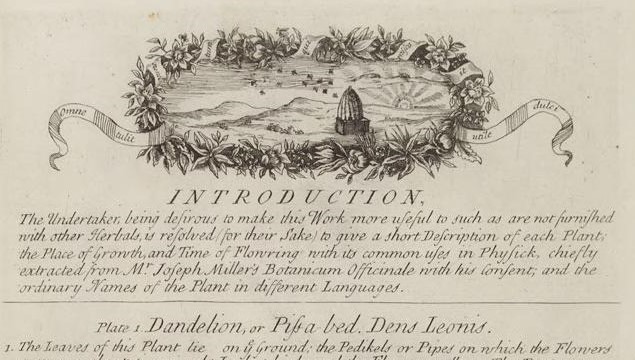
Elizabeth Blackwell (c. 1707-1758), the first woman to publish a printed herbal, drew upon several sources for her illustrations and text entries in A Curious Herbal. Containing five hundred cuts of the most useful plants which are now used in the practice of physick which was first published in 1737 and among them were specimens from the Apothecaries Garden at Chelsea. Blackwell undertook the project to raise money so that she could cancel her husband’s debts.
This article, however, is focused on connections that Blackwell forged between three print sources and the contents of A Curious Herbal. They are the Dispensatory (1721) of the Royal College of Physicians of London (RCP), by John Quincy (d.1722), the Botanicum Officinale or a compendious herbal: giving an account of all such plants as are now used in the practice of physick (1722) by Joseph Miller (d. 1748), and the Hortus Malabaricus or Malabar Garden (1678-1693), by Hendrik Van Reede (1636-1691) and Itty Achuthan Vaidyar (fl. second half 17th century).
The 1721 Dispensatory was identified in a letter of introduction that Blackwell presented to Hans Sloane (1660 – 1753). Dated 12 August 1735 and written for her by Sloane’s fellow physician Alexander Stuart (1673 – 1742), the letter noted that Elizabeth already had begun working on images for the herbal. Stuart described ‘Mrs Blackwell’ as ‘a very ingenious person, who drew the specimens of the Dispensatory Plants, which you have seen; of which she designs to complet the whole sett to about 500’ (BL Sloane Mss 4054, f.90).
Blackwell’s use of the 1721 edition was significant. The first edition of the RCP Dispensatory was published in 1618. A ninth edition had been printed in 1718, the year preceding Sloane’s first term as RCP President (a post he held until 1735). With his election, Sloane sought to modernise the RCP’s approach to medicine. Echoing Sloane’s initiative, John Quincy wrote in the new Dispensatory: ‘We have thrown out all those things which owed their rise to Superstition, and a false Philosophy; and endeavoured as far as the Nature of such Things could admit, to reduce all to the Test of Reason and Experience’ (Quincy, 1721). As such, the herbal reflected that turn towards modernisation.
The Dispensatory listed 752 plants as simples, Miller’s Botanicum contained entries on 620 herbs. Of the herbal’s 500 entries, about 485 indirectly came from the Dispensatory, via the Botanicum. Notably, just as the Dispensatory was not illustrated, neither was Miller’s book – Blackwell’s most important direct source of herbal knowledge. In such a light, it might be tempting to consider A Curious Herbal as an illustrated adjunct to Miller’s purely verbal book. But Blackwell’s descriptive illustrations allowed her to reduce the length of Miller’s verbal descriptions, and translate them into concise, list-like entries. Coupled with her pictures, they would have been more user-friendly to lay readers than was Miller’s specialist-oriented text. The work’s relatively high price was dispersed through being sold in fascicules of four plates, plus an explanatory page each, which cost 1 shilling plain, and 2 shillings coloured. The fascicules were collated by buyers, and the book sold well enough that a total of four editions were published in 1737, 1739, 1751, and 1782.
But what of the Hortus Malabaricus? Produced in twelve volumes, it contained 794 copperplate illustrations, and plant names in Latin, Arabic, Malayalum, among other languages and scripts. There was no English translation at the time. As such, Blackwell would have needed someone to translate the verbal information that she selected for use in A Curious Herbal. Miller or Robert Nicholls (d. c. 1750) – both of whom were apothecaries – might have provided that service. Blackwell cited the Hortus as a source for thirteen of her entries in A Curious Herbal, including those for ‘Malabar or Java Cinamon/Cassia lignea’ (plate 391) and below, for ‘The Nux vomica of ye Shops/Nux vomica in Officinus’ (plate 395).
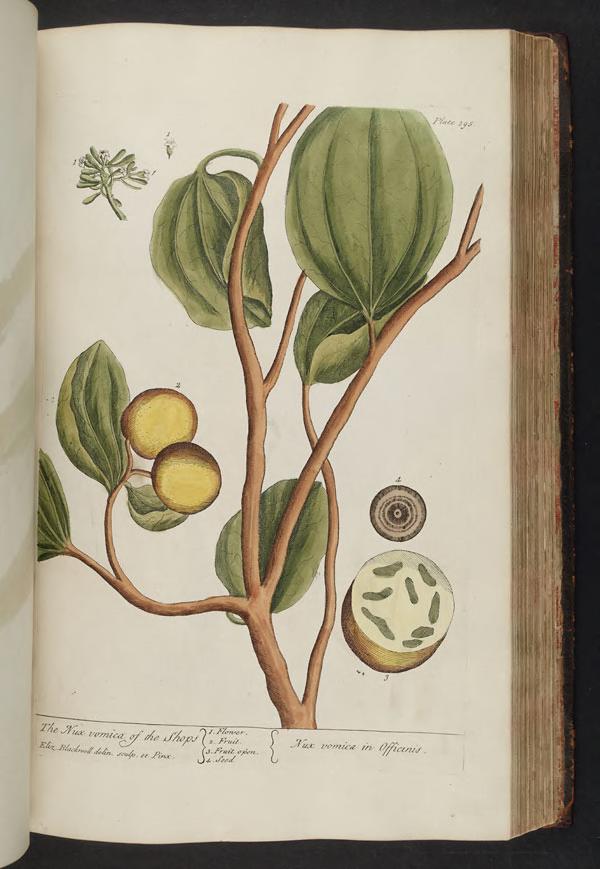
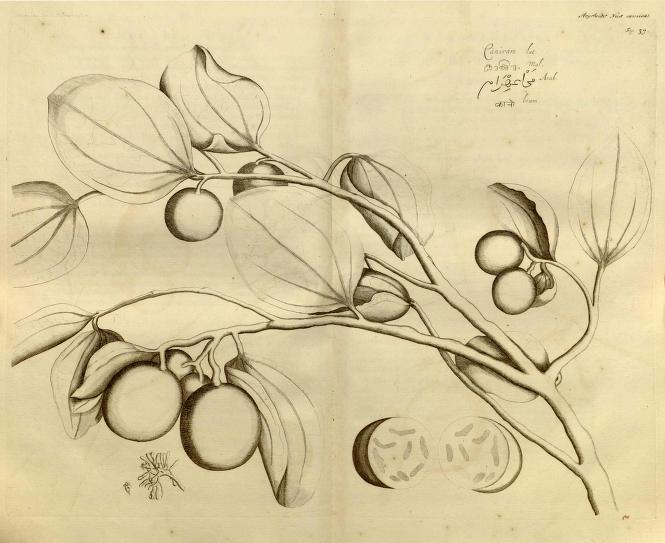
Nux vomica, ‘vomiting nut’, was listed (but not illustrated) in the Dispensatory’s ‘A Catalogue of Officinal Simples’ (Quincy, 1721) as ‘Nuces vomicae’. Miller wrote that vomiting nuts had no ‘physical Use’ apart from destroying ‘Cats, Dogs, &c.’ (Miller, 1722). In contrast, Blackwell noted that different parts of the tree that produced those nuts possessed ‘a great many Virtues’ – and that the picture she drew came from ‘the Malabar Garden Vol 1 Tab[le] 37 and the Seed from Mr Nicholls’ (Blackwell, 1739) as shown in Figure 1. In producing her picture of Nux vomica, Blackwell effectively paraphrased the image in the Malabar Garden, just as she paraphrased Miller’s words in almost all her entries. She would have traced only part of the picture (the right-hand side) and rotated it slightly so that the branch would appear to grow from the centre of the bottom of the page. She also eliminated some details to increase the visual impact of her own depiction, and added the nut, which she drew from a specimen that Nicholls supplied. After she transferred her drawing to a wax-coated copper plate, she used an etching needle to draw the image into the wax. Most likely a printer finished processing the plate, then used it to make multiple images on sheets of paper.
Blackwell wrote that the verbal and visual information she had compiled was intended to make A Curious Herbal ‘useful to such as are not furnished with other Herbals’ (Blackwell, 1737). But she also succeeded in making a beautiful, scientifically up-to-date reference book that impressed specialists and lay-persons, alike. If, as a pre-Linnaean reference, it became less relevant as a source of medical information, it was celebrated by Victorians as a token of commendable wifely devotion. During the twentieth century, interest in it took a feminist turn. At present, it seems that all three forms of appreciation are in play, with others undoubtedly in the offing.
References
Blackwell, E., (1737). A curious herbal. Containing five hundred cuts of the most useful plants which are now used in the practice of physick, Vol. 1. London: Printed for Samuel Harding. explanatory p. 1. [online] Available at: https://www.biodiversitylibrary.org/item/10361#page/6/mode/1up [Accessed 25 May 2021].
Blackwell, E., (1739). A curious Herbal. Containing five hundred cuts of the most useful plants which are now used in the practice of physick, Vol. 2. London: Printed for John Nourse. explanatory p. 99. [online] Available at: https://www.biodiversitylibrary.org/item/10362#page/6/mode/1up [Accessed 25 May 2021].
British Library, Sloane MS 4054. f 90. [online] Available at http://searcharchives.bl.uk/primo_library/libweb/action/dlDisplay.do?docId=IAMS040-002116448&fn=permalink&vid=IAMS_VU2 [Accessed 25 May 2021].
Miller, J., (1722). Botanicum officinale; or a compendious herbal: giving an account of all such plants as are now used in the practice of physick. London: Printed for E. Bell in Cornhill, J. Senex in Fleet-Street, W. Taylor in Paternoster-Row et al. p. 316. [online] Available at https://archive.org/details/b30522638_0001 [Accessed 25 May 2021].
Quincy, J., (1721). The Dispensatory of the Royal College of Physicians in London: with some notes relating to the manner of composition, and remarks on the changes made in most of the officinale medicines, from the first prescribers down to the present practice. London: W. Bowyer, unnumbered Preface pp. 5 - 6; p. 326. [online]. Available at: https://archive.org/details/b30523382_0001 [Accessed 25 May 2021].
Van Rheede, H., (1678). Hortus Malabaricus. Vol 1. Amsterlaedami: Sumptibus Vidae Joannis van Someren, Haeredum Joannis van Dyck, Henrici and Viduae Theorori Boom. [online] Available at: https://archive.org/details/HortusMalabaricus [Accessed 25 May 2021].
Biography
Janet Stiles Tyson MFA MA MS is a PhD candidate at Birkbeck University of London. Although her garden includes a variety of culinary herbs, her primary interests are printmaking and the history of books. Her doctoral thesis concerns Elizabeth Blackwell’s collaborative production of A Curious Herbal.