
‘The subject of simple drugs, most honoured Andromachus, is naturally more agreeable than that of compounds, since it is readily understood and its materials are readily available.’
So opens the treatise On Simples attributed to Dioscorides and now translated into English by John Fitch (Fig. 1).
Though not written by Dioscorides, the most authoritative Greek author on medical materials, animal, vegetable and mineral, and of uncertain date (somewhere between the first and fourth centuries CE), this is an important text nonetheless. Simples—remedies based on a single active ingredient (mostly plant products)—were the bread and butter of ancient Greek and Roman medicine, but this is the only extant treatise dedicated to the subject. Similar works, entitled Euporista—that is focusing on the ‘readily available’ quality of the items utilised—or cast as self-help manuals for travellers and those wishing to avoid being ripped off or killed by greedy and incompetent doctors, do survive. They are also often transmitted in anonymous or pseudonymous form. There are overlaps in terms of organisation and contents, but also differences between these writings (see Totelin 2021).

Women’s Bodies and Reproduction
One of the features this tradition tends to share is a particular interest in women’s bodies and reproduction, part of a wider emphasis on everyday issues—from black eyes and chafing to bedwetting and fatigue. On Simples provides materials for intervention around menstruation, conception—sullēpsis—the initial grasping of the seed in the womb, the solidifying of the seed and the holding of the foetus in the womb, the sex of the foetus, birth, and the expulsion of the afterbirth.
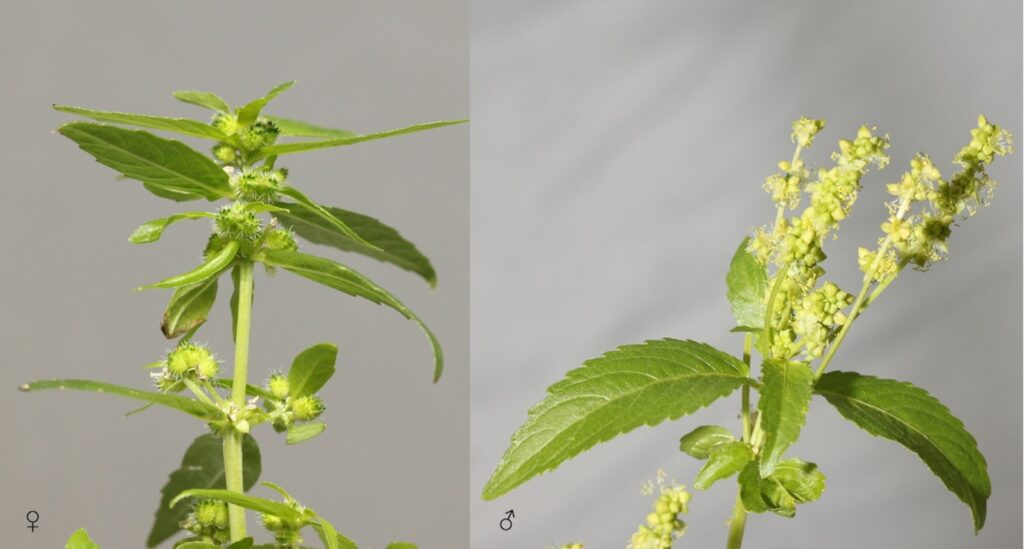
It is important to note that these interventions variously promote and/or hinder the generative processes, all within the broader frame of female health. Thus, for example: pessaries which help towards conception include (according to Fitch’s plant identifications, some debateable): ajwain with marrow, hare’s rennet with butter, and the seed or juice of annual mercury (Simples 2.95). Pessaries with the opposite effect include ground up mint, ground-up cabbage-flower, seed of ‘axe-weed’, or moist alum (2.100). Most are applied before intercourse. Administered later, ‘it is said’ (2.96.2), the seed of the male mercury plant produces male offspring and the seed of the female plant female (See Fig. 2).
The long lists of substances which draw out the menses, afterbirth and even the foetus, comprise a more complex matrix of possibilities. That last action certainly includes what would now be termed abortions and is the version requiring the most potent application. Many items possess only the capacity to move the menses and afterbirth, and sometimes only ‘moderately’ at that (2.79.1). Both of those interventions might be considered primarily supportive of female health and fertility. Failure to expel the afterbirth was very dangerous, and menstruating was generally viewed as fundamental to women’s bodily balance and her procreative ability.
Expelling the Foetus
Items with a sufficiently intense drawing-down effect to expel the foetus were still many and varied. The plant ingredients include (2.81): juice of horehound, fruit of evergreen honeysuckle, seed of wild rue or root of male fern all drunk with wine or honey-water; bryony root with water (though this disturbs the mind), gum ammoniac, and silphium sap or seed with myrrh and pepper (the more exotic and expensive option). Similar ends could be achieved through pessaries and to a more limited degree through fumigation and sitz-baths, involving some of the same materials, with some variations and additions.
It is once noted that the foetus being thus expelled had already died in the womb (2.81.2), and it is conceivable that there is some overlap here with the amulets to ease difficult births (2.98), that some of these prescriptions could be deployed to speed up parturition. In general, however, the abortives are abundant, while only a single remedy is explicitly provided to women liable to miscarriages (literally who have a ‘slippery’ womb). 41 seeds of black cumin tied in a linen cloth and worn in the hair will help keep the foetus secure and bring the pregnancy to term (2.97). Uterine health is certainly a wider concern, with plenty of substances to counter inflammation, pain and hardening, for example.
Fertility control?
The overall sense is thus of flexibility and range. The treatise presents a wide array of ingredients and applications which could affect fertility and childbearing in many different ways. They could be used to support shifting and diverse reproductive projects, and intervene more directly in female health. If ‘fertility control’ is too strong a term for this, then some other encompassing formula needs to be found to do this portfolio justice (Flemming, 2021). And, of course, the precise contexts of use, whether by women themselves, and on their own account, or in more collective or coercive situations, is left open, unclear but with possibilities.
References
Beck, L. Y. (2005). trans. Pedanius Dioscorides of Anarzarbus De materia medica. Hildesheim: Olms-Weidmann.
Fitch, J. G. (2022). On Simples, Attributed to Dioscorides: Introduction, Translation, Concordances. Leiden: Brill.
Flemming, R. (2021), Fertility control in ancient Rome. Women’s History Review, 30, pp. 896-914. doi: 10.1080/09612025.2020.1833491
Totelin, L. (2021). Easy remedies – difficult texts: the Pseudo-Galenic Euporista’. In C. Petit, S. Swain and K.-D. Fischer eds. PseudoGalenica: The Formation of the Galenic Corpus from Antiquity to the Renaissance. London: The Warburg Institute. pp. 31-45.
Wellmann, M. (ed: 1906-1914), Pedanii Dioscuridis De materia medica libri quinque. 3 vols. Berlin: Weidmann.
Further Reading
Foxhall, L. (1998). Natural sex: The attribution of sex and gender to plants in ancient Greece. In L. Foxhall and J. Salmon eds. Thinking Men: Masculinity and its Self-Representation in the Classical Tradition. London: Routledge. pp. 57-70.
Hardy, G. and Totelin, L. (2016). Ancient Botany. London: Routledge.
Hopwood, N., Flemming, R. and Kassell, L. (2018). Reproduction: Antiquity to the Present Day. Cambridge: Cambridge University Press.
Biography
Rebecca Flemming is A.G. Leventis Professor of Ancient Greek Scientific and Technological Thought at the University of Exeter. She has published widely on classical medicine, reproduction, gender and sexuality, both separately and together, and has a forthcoming book on medicine and empire in the Roman world. https://classics.exeter.ac.uk/staff/rflemming/