By Debby Banham, Affiliated lecturer in the Department of Anglo-Saxon, Norse and Celtic, University of Cambridge.
For decades, historians of medieval medicine have bemoaned the lack of a modern edition and translation of Bald’s Leechbook, the oldest surviving collection of medical recipes in the English language. The pioneering edition of the Reverend Thomas Oswald Cockayne (Cockayne, 1864-6, vol. 2), made the whole corpus of Old English medical texts available to the reading public for the first time ever (and invented their titles), but, as Anne van Arsdall has pointed out, Cockayne’s archaising translation has made the texts he edited seem a curiosity, rather than part of the mainstream development of medicine in western Europe (van Arsdall, 2002). Also as Dr Christine Voth found out in the course of her PhD research on the manuscript, Cockayne did not always reproduce in print what he found in the original, either. Even the most scrupulous editor makes mistakes sometimes, but the conclusion was unavoidable that Cockayne sometimes altered the text, either to make it resemble what he believed were its Latin or Greek sources, or to make it mean what he thought it ought to, which he then presented in his translation.
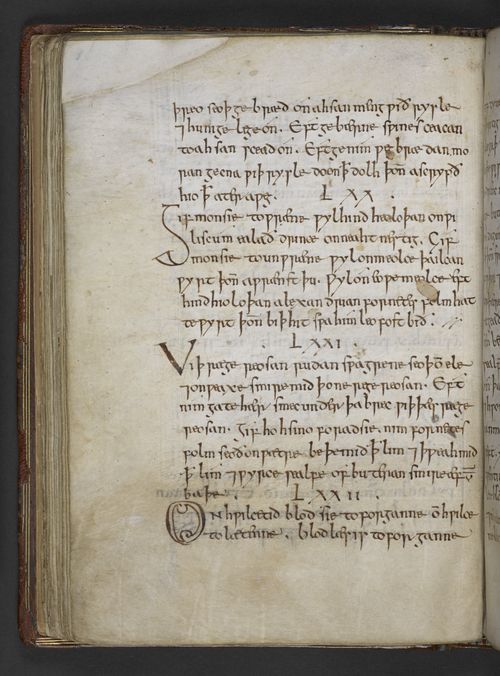
Why are we so interested in Bald’s Leechbook? Probably compiled in the ninth century, it is preserved in a tenth-century manuscript, British Library, Royal MS 12 D xvii, along with a slightly later compilation, Leechbook III. That makes it the oldest surviving recipe collection in any western European vernacular (though a single leaf exists of what was probably an older English collection, the ‘Omont leaf’, Louvain, Université Catholique, Fragmenta H. Omont 3). England had a medical literature in its own tongue long before its continental neighbours. We can identify where our texts were written, whereas the contemporary Latin texts could have originated anywhere in western Europe, but there is also a risk of vernacular material being seen as a ‘backwater’, separate from the Latin tradition. Modern editions of the other major Old English texts, the Old English Herbarium (de Vriend, 1984) and the Lacnunga (Pettit, 2001), have helped to counteract that impression, but there remains much work to do to overcome the ‘eye of newt’ image of early medieval medicine.
Bald’s Leechbook itself is the most comprehensive and systematic of the Old English collections. (The Old English Herbarium is systematic, in ordering its recipes according to their main ingredient, but makes no attempt to cover the whole body and all its ills.) It is arranged in two books, the first covering diseases of the visible body in head-to-toe order, the second dealing with internal and general disorders. Each part of the body, or type of illness, is given its own chapter, ranging from one recipe to over twenty. Most of these are relatively short, with few ingredients. The Leechbook’s materia medica is overwhelmingly herbal, although there is a surprising amount of animal-based medicine. In all these respects, the Leechbook is very similar to the Latin medicine that circulated at the same time, and quite a few of its recipes are translations of known Latin ones.
The identity of our compiler is a bit of a mystery. The name Bald comes from a Latin verse at the end of Book 2, which says that Bald told Cild to ‘conscribere’ the book. Both persons are otherwise unknown, and the verb ‘conscribo’, literally ‘write together’, is ambiguous. Did Cild compile the collection, did he translate it, or did he simply copy it out? Was he a medical specialist, was Bald, or were they both part of a group of practitioners and writers? Whoever translated the recipes was clearly well versed in medical knowledge. They understood the technical terms in the Latin, and translated them into English that was similarly technical, sometimes using existing medical vocabulary, sometimes translating literally, so that the meaning of the original was transparent. And it wasn’t only Latin they understood. Greek terms, untranslated in medical Latin, were turned into English: ‘podagra’, for example, meaning gout, but literally ‘foot squeezing’ in Greek, became ‘fotadl’, foot disease, in Old English. Dr Voth and I have been consistently impressed by the breadth and depth of knowledge displayed by the text.
But it is important to remember that this is medicine from a very remote era. We cannot expect everything to translate into modern English, or modern concepts, in a straightforward way. Dr Voth has been wrestling with a disease name, ‘theoradl’, which has resisted resolution. The problem is partly that disease entities were conceived of differently in the Middle Ages, so ‘theoradl’ might not line up exactly with any illness recognised in the modern world. The plant names, too, have proved to be a thorny category of vocabulary. We are lucky to have Professor Maria Amalia D’Aronco, a leading expert on Old English botanical vocabulary, editing the Old English Herbarium for the same series, Dumbarton Oaks Medieval Library. Even so, many names will undoubtedly remain unresolved, for similar reasons – the Linaean concepts of genus and species lay far in the future, so identifying ‘the same plant’ in Old and modern English may be an unachievable goal – but we hope to arrive at a better idea of the early English materia medica than Cockayne provided.
References
Cockayne, T.O. (1864-6). Leechdoms, wortcunning and starcraft of early England, Vols 1-3, Rolls Series.
De Vriend, H.J. (1984). The Old English Herbarium and Medicina de quadrupedibus. Early English Text Society, original series 286.
Pettit, E. (2001). Anglo-Saxon remedies, charms and prayers from British Library MS Harley 585: the Lacnunga. Vols 1-2. Lampeter: Edwin Mellen Press.
Van Arsdall, A. (2002). Medieval herbal remedies: the Old English ‘Herbarium’ and Anglo-Saxon medicine. New York: Routledge.
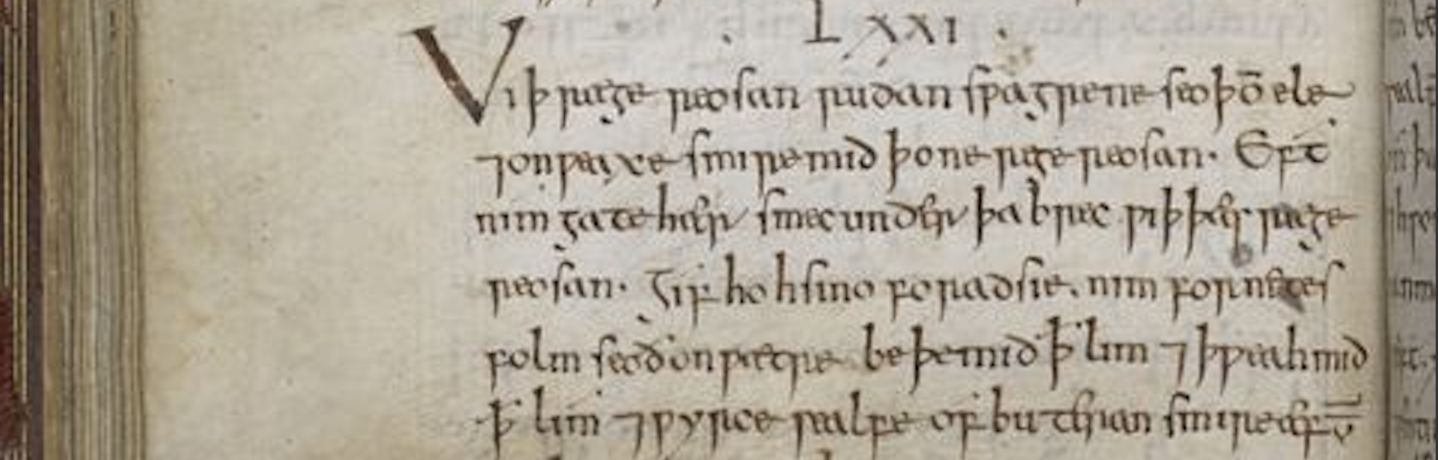
Picture caption: British Library, Royal 12 D. xvii, folio 54 verso, a page of recipes from Bald’s Leechbook (image courtesy British Library).