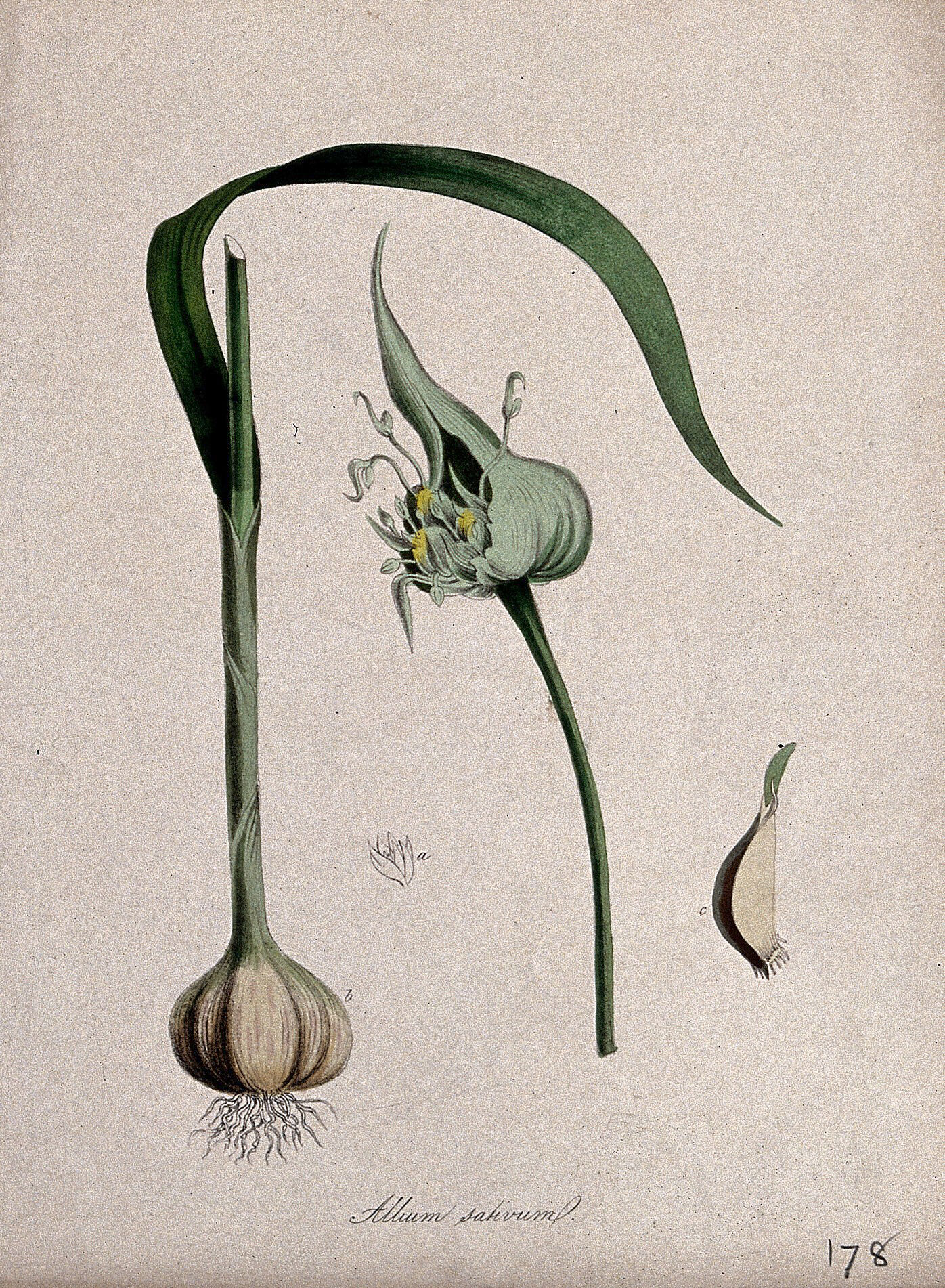
Credit:Common garlic Allium sativum: bulb, flower head, single flower and single clove. Coloured lithograph after M. A. Burnett, c.1850. Source: Wellcome Collection.
By John Wilkins, Professor Emeritus of Greek Culture, University of Exeter
Fabrizio Bigotti and I released the edited volume Galen’s Remedies in the Early Modern Period: Traditions, Theories, Transformations and Trades (1400-1750) in April 2026. The volume offers new thinking on the reception of Galen’s pharmacology (before it was called pharmacology), tying in the latest on Galen’s Simple Medicines (2nd century AD) with what his supporters and opponents wrote in the period 1400-1750.
We present new studies on how drugs worked (Holmes, Moreau and Blank on substance), on Galen’s methods reconsidered; on the Arabic and Byzantine contribution to the tradition; and on new plants; new botany (Haars); and a new understanding of drugs from animals (Richards on coral). De Vos shares little-used Spanish archival material, as does Alcover Crateua on guiacum in Majorcan documents, a chapter that has already stimulated lively discussion on the Herbal History Network. Touwaide considers Simples manuscripts in the Byzantine tradition, Screti domestic manuscripts.
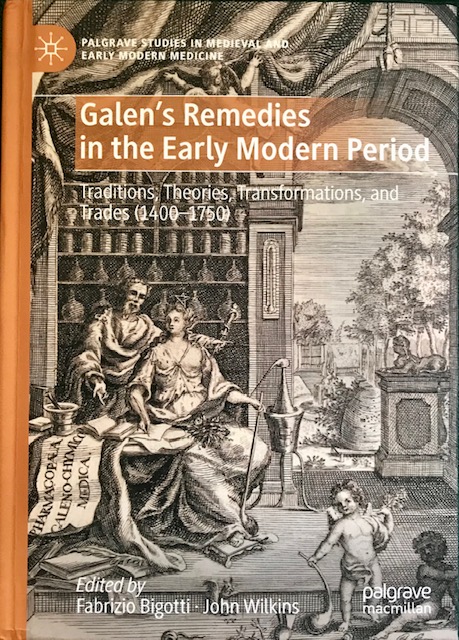
Vicki Pitman (2026)
Our volume contains some of the papers from a conference held in Pisa in 2022 at the Centre for the Study of Medicine and the Body in the Renaissance, which is directed by Fabrizio. We assembled the papers according to the four categories of the subtitle, and also so as to focus explicitly on the Early Modern Period. One of the prompts for the conference was my translation of Galen’s Simple Medicines (books I-V) for the Cambridge Galen Translations series (CUP). This is the first translation into a modern language of Galen’s ground-breaking treatise, a translation based on Kühn’s unreliable edition of 1826, corrected against two manuscripts – one in Venice and the other in the Vatican. I have also consulted Iman Darwish on the Arabic translation of the 9th century, which is the oldest text to survive. My translation is scheduled for publication in 2028 as other Galen translations are in the pipeline.
This translation and articles derived from it allows us to see clearly what is Galen’s original work and what are later additions. My introduction with Fabrizio sets out Galen’s approach to drug causation, which is based on their activation by the heat of the body. (This contrasts with early chemistry which saw drug substances in their totality. Galen thought such an approach part of natural philosophy (physics) and inappropriate for medicine.)
A drug’s potential lies in the four primary qualities hot, cold, wet and dry and also in secondary qualities, flavour in particular. These qualities create change in the body, to restore its natural balance. Galen made the first steps towards measuring intensity on a scale of one to four, with three divisions in each degree, but it was Arabic doctors who saw that more mathematical precision was needed; Early Modern scholars then developed mechanical means of measurement. As with the anatomy of Vesalius and the blood circulation of Harvey, Galen was corrected in this period through developments of his own methodology.
On Byzantium, Alain Touwaide shows that the theoretical books I-V of Simples were much less copied than the following six books of catalogued drugs. Doctors wanted only the drug descriptions, supplementing them in many copies with quotations from Dioscorides’ De materia medica. This composite Greek tradition thus had less theoretical engagement with Galen than did the Arabic tradition which for its part raised doubts and debate about Galen’s understanding of substance.
Next in the ‘Traditions’ section, Simone Mucci explores how four Early Modern scholars discussed Galen’s less-known Antidotes, one of the treatises based on Simples (along with two long works on compound drugs). Thirdly, Maximilian Haars compares the works of Leonard Fuchs and Janus Cornarius on plants. Fuchs worked hard to match Galen’s findings with the botany of his own day and found Galen largely correct, any deviation being explained by differences of species in the modern evidence. Cornarius was more a philologist, but both men produced valuable pharmacological tables. Finally in this section, Vivian Nutton studies Lorenz Gryll’s study of flavours in Germany, a topic to which Galen devotes a whole book (4) of Simples.
Fabrizio’s own chapter takes up the question of intensity and dosage, tracing this vital topic through Arabic and Early Modern authors as drugs were seen as substances with their own properties rather than being restricted solely to properties activated by body heat. Fabrizio’s study brings us towards pharmacology as it came to be defined. Next in ‘Theories’ Brooke Holmes explores theoretical ideas of sympathy, antipathy, whole substance and causes difficult to explain, topics of concern to Galen and later antiquity, particularly to Jean Fernel, the theorist also discussed by Elisabeth Moreau. By the “change in whole substance” Galen meant principally the body’s process to transform a food such as bread into blood suitable for distribution to all the body parts. Andreas Blank continues questions of substance with a focus on whole substance and antidotes.
In ‘Transformations and Trades’ Pablo José Alcover Crateua examines medicine, trade and regulation in Majorca, while Paula De Vos shows how Galen was taken to Mexico in order to accommodate Colombian plants into the system and transfer European plants into Mexican soil. In the final section, ‘Between Tradition and Transformation’, Zoe Screti’s study of domestic manuscripts brings Galen and iatrochemistry together in the world of the household, at the practical end of the spectrum of knowledge transfer from Fernel’s speculations on the soul. The book concludes with Francesca Richard’s study of Corallium rubrum in the Early Modern world, taking a substance known to Galen but made much more available to medicine in the later period.
References
Adamson, P., (2022). Al-Razi. Great Medieval Thinkers. Oxford: Oxford University Press.
Barry, J., and Bigotti, F. (eds.) (2022). Santorio Santori and the Emergence of Quantified Medicine: Corpuscularianism, Technology and Experimentation. London: Springer.Palgrave-Macmillan.
Bouras-Vallianatos, P., and Zipser, B., (2019). Brill’s Companion to the Reception of Galen . Leiden and Boston: Brill.
Nutton, V., (2022). Renaissance Medicine. Abingdon: Routledge.
Singer, P.N. and Rosen, R.M., (eds.) (2024). The Oxford Handbook of Galen. New York: Oxford University Press.
For earlier blogs by John regarding Galen’s work see Part 1 and Part 2
Biography
Professor Wilkins is a specialist in the history of food and medicine in Greco-Roman culture, with current interests in literature (eg comic drama) and medicine (especially nutrition). His translation of Galen’s Simple Medicines, Books I-V is shortly to be published by Cambridge University Press.