Herbal History Researcher Profile: Frances Watkins
Interviewed by Anne Stobart
Frances Watkins is a practising herbalist and completed her doctorate in 2013 at the University of East London investigating antimicrobials from native British plants mentioned in early medieval wound healing remedies.
1. Tell us about the main focus of your herbal history research and why it matters?
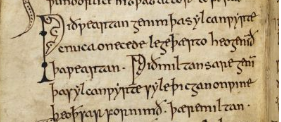
Whilst I’ve always been interested in plants it was not until about 10 years ago when studying for my doctorate that I became fascinated with herbal practice in the early medieval period. The surviving literature is only a glimpse of what would have been in circulation at the time. In the last couple of decades, there has been a shift in opinion with historians acknowledging the herbal remedies that were used to treat the sick. As a practising herbalist, I am intrigued to know what elements of our tradition have been transferred by the written word as well as the oral transmission of knowledge found in herbal folklore today. During one of my visits to the British Library I came to hold a codex believed to have been compiled in 10th century England that caught my attention. The style of pen drawn remedy initials found at the beginning of each plant chapter in the Old English translation of the Herbarium text (Figure 1) continues in the subsequent collection of remedies known as the ‘Lacnunga’ (British Library, MS Harley 585). I am currently developing a hypothesis exploring how the decorated remedy initials in MS Harley 585 add value to the written formulas.
2. How did you get started in researching herbal history?
Most of my career has been in marketing communications and public relations, working for both high street retailers and consumer technologies. Although I have had an avid interest in plants from an early age it is only since the millennium that I was able to study herbal medicine and qualified as a medical herbalist at Middlesex University (2009). In the autumn of that year, I saw an advertisement for a studentship in the Medicines Research Group at the University of East London (UEL) to explore potential leads in drug discovery from medieval manuscripts. It was serendipity in that I saw the advertisement online only a few hours before the submission deadline. Following a panel interview, some weeks later I was offered the position and began reading English translations of the herbal texts. I remember my first time of reading Cockayne’s 1864 translation of the Old English literature, thinking, this is a home coming and practising herbalists need to know more about their roots!
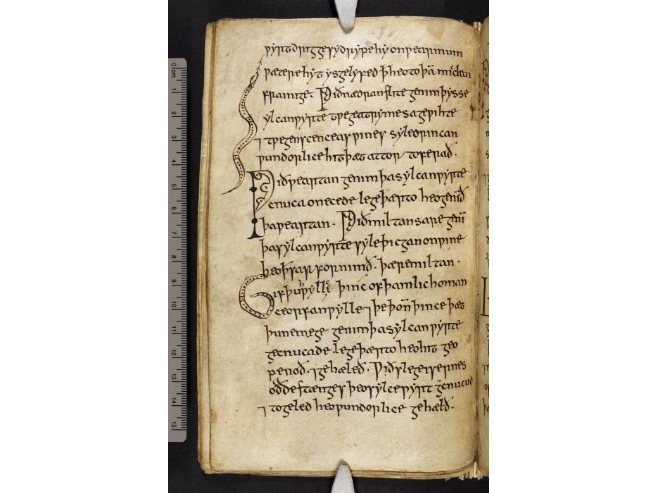
agrimony (British Library, MS Harley 585, f.30v).
3. What training/experience have you found most helpful?
Postgraduate studies included extended teaching of research methods as well as practical lab skills in using the analytical instruments and supervising international biomedical students during the summer. A five-day intensive workshop on medieval and manuscript studies in the digital age was funded by the Digital Scholarly Edition and Initial Training Network (DiXiT). It was hugely beneficial and gave me a valuable insight into manuscript production through the ages, a greater understanding of a theoretical foundation and experience in cataloguing and editing digital and print manuscript formats.
More recently I have enjoyed the Wellcome online seminars given by PhD candidates and hopefully, these will continue after lockdown. They are free to attend and copies of the presentation available afterwards. The Society of Historical Alchemy and Chemistry (SHAC) also offer monthly seminars to members and non-members and these are freely available. These seminars are particularly informative, broadening my understanding of other plant practices for example, early 20th century use of dyes in commerce and medicine.
4. Tell us about your most recent/forthcoming publication in herbal history!
I have two draft manuscripts awaiting completion; the first from my PhD research (Watkins, 2013) looking at the antimicrobial activity of betony leaf infusions and root decoctions. Betony was considered by the early medieval physicians to be a panacea. As seen in the Old English illustrated copy of the Herbarium (British Library: Cotton Vitellius C.III) betony was assigned the largest number of formulations with some 29 remedies which were mainly simples. The second manuscript outlines my hypothesis that additional information relating to the herbal formulas in MS Harley 585 is contained within these remedy initials and hopefully, with a final draft be ready to submit the manuscript for peer review.
5. What advice about writing herbal history would you like to pass on to upcoming researchers?
When looking at herbal remedies in the ancient texts I do so through the lens of a clinical herbal practitioner. And I continually ask myself how the medieval formulas were prepared, trying not to project contemporary methodologies/assumptions onto the past. On saying that, it is surprising how familiar many of the remedies seem to me! Some preparatory methods are retained as instructions in the formulas whilst other knowledge has been transmitted orally as part of our folklore tradition. In time, I’m sure, more remedies will be proven to be efficacious for the recommended use as shown in my doctoral research of medicinal infusions and decoctions used in medieval wound healing remedies (Watkins et al, 2012).
6. What further herbal history question would you like to see answered?
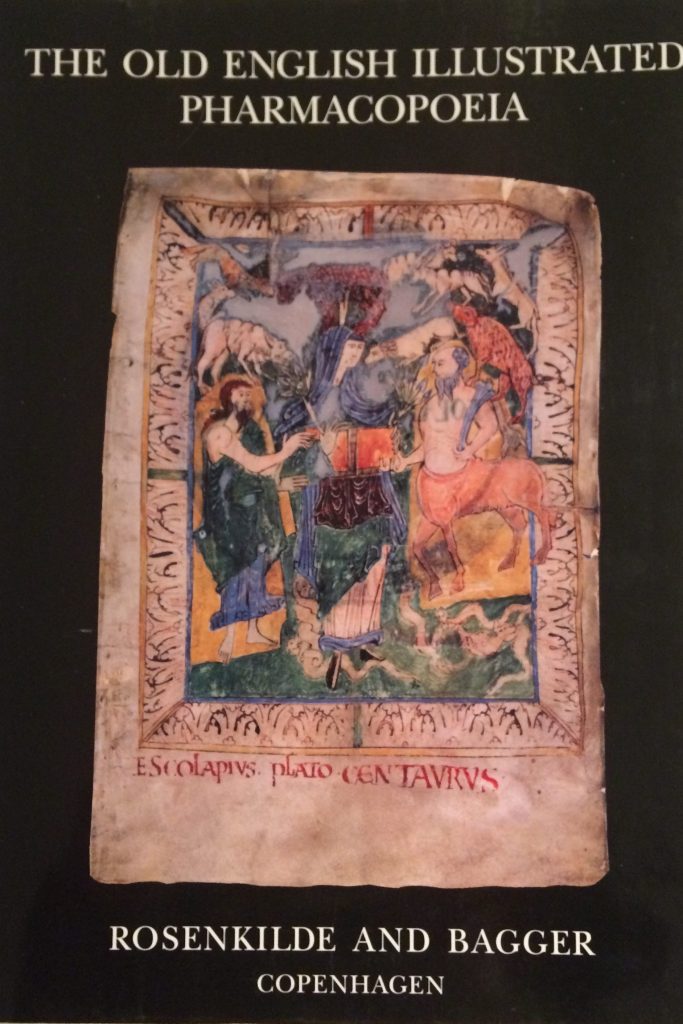
According to D’Aronco and Cameron (1998) more than 130 of the medicinal plants mentioned in the Old English Herbarium can be found in contemporary herbal encyclopaedias (Figure 2). Given the current Covid-19 pandemic, the Herbarium is a rich medieval resource for identifying plants used in cough, cold and fever remedies and provides a starting point to analyse the pharmacological efficacy of plants mentioned. Herbal history research would benefit from more herbalists publishing their knowledge and researchers having a greater awareness of herbal practice as a living profession with both written and oral tradition forming its foundation.
References
Cockayne, O., (1864). Leechdoms, wortcunning, and starcraft of early England: Being a collection of documents, for the most part never before printed, illustrating the history of science in this country before the Norman Conquest. Vols 1-3. Reprint. London: Thoemmes Press, 2001.
D’Aronco, M. A. and Cameron, M. L. eds. (1998). The Old English illustrated pharmacopoeia. Copenhagen: Rosenkilde and Bagger.
Watkins, F. (2013). Investigation of antimicrobials from native British plants used in 10th century Anglo-Saxon wound healing formulations. PhD from the Medicines Research Group, School of Health, Sport and Bioscience, University of East London. [online] Available at https://repository.uel.ac.uk/item/85vww [Accessed 05 January 2021].
Watkins, F., Pendry, B., Sánchez-Medina, A. and Corcoran, O. (2012). Antimicrobial assays of three native British plants used in Anglo-Saxon medicine for wound healing formulations in 10th century England. Journal of Ethnopharmacology, 44(2) pp. 408-15.