by Emma Spary & Paul Nulty
Names are useful for the historian to work with—but they must also be associated with specific kinds of plants before classification can happen. Conferring names—the privilege accorded to Adam in Scripture—also confers the power to order, relate and manipulate, as early modern authors well understood. Prior to the universal scientific acceptance of Linnaean nomenclature, indeed before Linnaeus himself had published a single book, naming was not necessarily correlated with the identification of distinct species. Protestant naming projects like those of Carolus Linnaeus or John Ray seem to have been more likely to aim at enumerating individual species, each with their own essence, than Catholic ones, for which the genus was a more important epistemological unit. Our project studies the ways herbs were referenced in c.180 Francophone recipe books published between 1660 and 1730. This involves drawing up a list of searchwords—names used for herbs in this literature. These names can be further investigated using computer analysis: for example, to learn which plants were most often associated with one another in recipes, or which were associated with particular diseases. However, we’re keenly conscious of the way our decisions about what counts as a distinct ‘kind’ of plant in historical sources may be functioning to shape our conclusions.
Lay pharmacology and plant differentiation
Our end goal is to shed light on what one might call ‘lay pharmacology’. Some of our recipe book authors spelt out the effects of particular plants in detail. Others (the majority) simply published recipe collections without such explanation. Some authors included a large number of different plant names, others very few. But by analysing as many printed recipes as we can—to date, c.30,000—we hope to produce a picture of therapeutic norms in practice. This focus on practice also governs our decisions about how to name and differentiate plants. Some scholars working on similar projects have opted to translate each plant into a modern taxonomic equivalent. This, however, is not an expedient we can adopt, because of the lack of specificity in the use of names by early modern authors. Take ‘sage’, for example. In recipes, some authors provided specific information about which sage should be used—’Greek sage’, ‘narrow-leaved sage’, and so on. Others simply wrote ‘sage’. It might seem obvious to us as moderns that ‘black hellebore’ and ‘white hellebore’ were different species: we now count only the former in the genus Helleborus. The latter is a completely different genus, Veratrum. If aiming to differentiate between species, why stop there? Perhaps we should also differentiate between purple and white violets, or sweet and sour cherries, which we would not today consider separate species: but for early modern authors, colour remained an important aspect of efficacy, so might be relevant for differentiation. In other words, to what level of specificity should we descend in hopes of capturing useful relationships?
Market localism
Our approach is to consider the desired outcome of using a given herb. That is, we prioritise perceived efficacy. Most botanists agreed that it was possible for only one species in a genus to possess the virtues required for cure, while others remained inefficacious. However, botanists in France were usually physicians. Few actually had anything to do with the sourcing or preparation of plants. This was something which fell to herbalists, apothecaries and end users, all of whom routinely substituted plants under the same name. The consequences of such market localism is clear in images from early herbals. Thus Leonhart Fuchs’ image (Figure 1) of Helleborus niger (in Southern Germany) corresponds to a plant with a different name today – H. viridis – and is not the ‘same’ plant as that shown by Otto Brunfels (in Switzerland) under the name of H. niger (Figure 2).
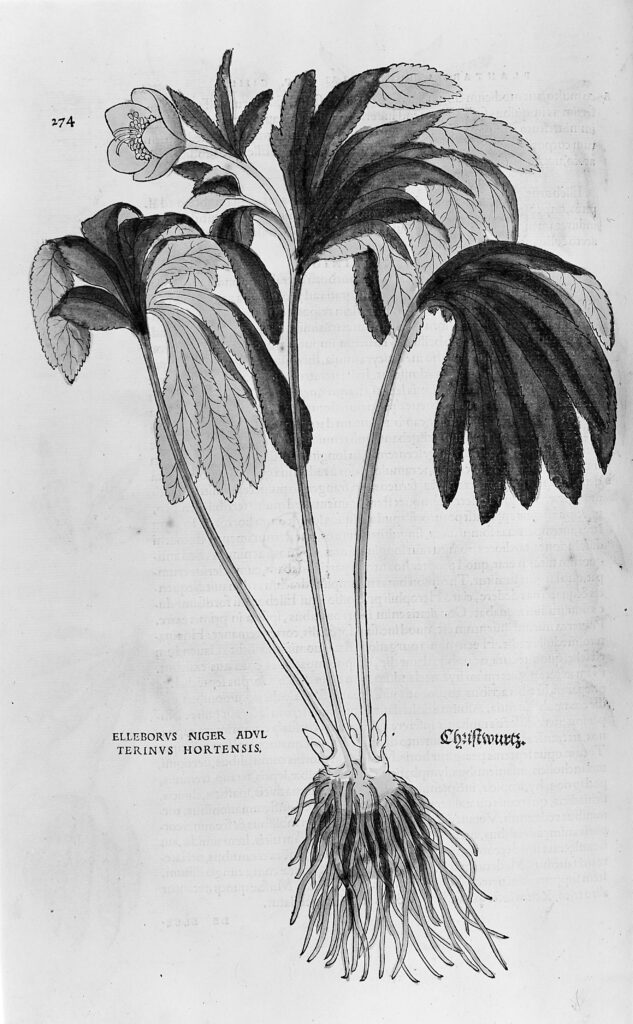
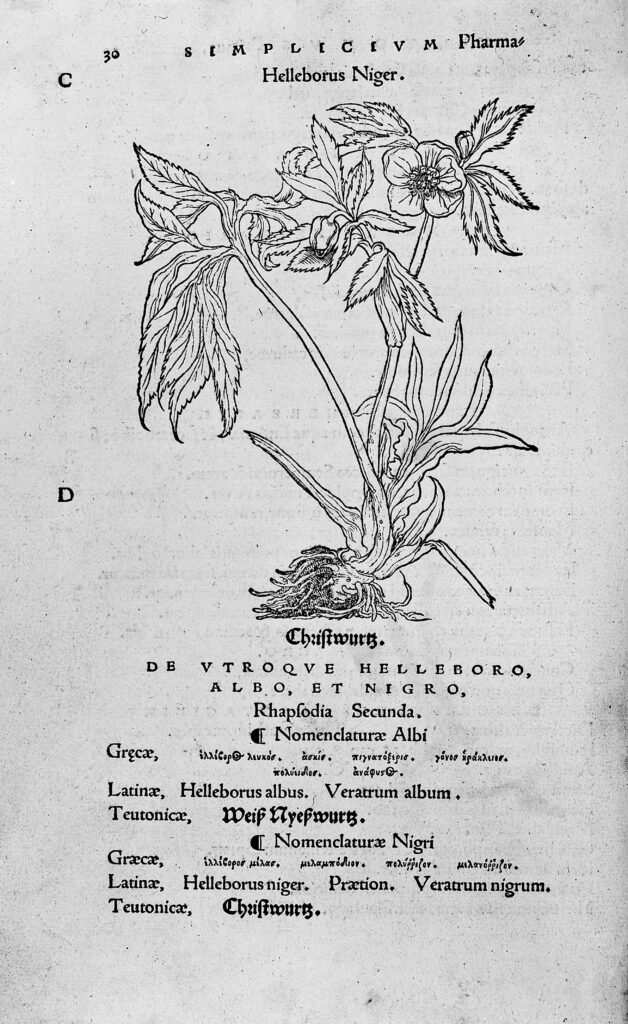
Figure 2: Otto Brunfels, Herbarium vivae, p. 30. Plate showing Helleborus niger, ‘Christwurtz’. Credit : Wellcome Images, CC BY 4.0
However, what Fuchs illustrated was very probably the kind of hellebore he most frequently encountered in his area. Apothecaries and herbalists commonly sold the local version of a particular plant in this way. Indeed, there was a theoretical defence of so doing by 1660—a century earlier, a debate had broken out around the European scholarly world over whether or not Providence had placed local cures at hand for medical purposes, as Alix Cooper shows in her book Inventing the Indigenous. The echoes of this debate certainly reached France too, and may account for why the most famous botanist there, Joseph Pitton de Tournefort, named so many of the plants he saw on his visit to the Levant in 1700 as ‘oriental’ versions of familiar European ones: Sorbus orientalis, Betonica orientalis, Orchis orientalis… During this period, in other words, the distinction between ‘species’ and ‘genus’ was not always upheld in either practice or theory.
Ordinary action and occult virtues
Ultimately, given our source material, we decided to adopt this perspective as well, on the basis that it was the one shared by end users—those people who actually read the recipe books we were studying (for example, see Figure 3) in hopes of confecting cures for themselves or family members. So we are listing the ‘common denominator’ name—where a plant was frequently identified under one name (‘sage’, ‘hellebore’) in recipes without further differentiation, we are assuming that ordinary practice likely involved substitution on a regular basis, by location or availability. Using this approach, we have ended up with a list containing something under 700 different ‘kinds’ of herb, a considerable reduction on contemporary botanists’ boasts of knowing ten thousand plant species. The actual consequences of this for efficacy are not, however, something the historian can access, only speculate about. Even for contemporaries, the virtues of herbs were universally understood to be occult—that is, concealed from human understanding. We feel it is vital, in pursuing our research question, to adopt these historical actors’ positions if we are to say anything useful about what claims recipe book authors were tacitly making about the curative powers of herbs.
Acknowledgements
Our project, ‘Applying digital humanities techniques to early modern French recipe books (1660-1730)’ was funded by the Gerda Henkel Trust, https://www.gerda-henkel-stiftung.de.
References
Brunfels, Otto. 1530. Herbarum vivae ei coneb [sic, i.e. eicones] ad naturae imitationem, summa cum diligentia et artificio effigiatae, unà cum effectibus earundem, in gratiam veteris illius, & jamjam renascentis herbariae medicinae. Argentorati: Joannem Schottum.
Cooper, Alix. 2007. Inventing the indigenous: local knowledge and natural history in early modern Europe. Cambridge: Cambridge University Press.
Fuchs, Leonhart. 1542. De historia stirpivm commentarii insignes … adiectis eorvndem vivis plvsqvam quingentis imaginibus. Basel: Isingrin.
Tournefort, Joseph Pitton de. 1703. Corollarium institutionum rei herbariæ, in quo plantæ 1356. munificentiâ Ludovici Magni in Orientalibus Regionibus observatæ recensentur, & ad genera sua revocantur. Paris: Imprimerie du Roi.
Biographies
Paul Nulty (Birkbeck College, University of London)
https://www.dcs.bbk.ac.uk/about/people/academic-staff/paul-nulty
Paul Nulty is a lecturer in the Department of Computer Science and Information Systems at Birkbeck, University of London. His research focuses on applying natural language processing and data visualisation methods applied to questions in the social sciences and humanities. Prior to joining Birkbeck, he completed postdoctoral research on computational social science and digital humanities projects at the LSE and Cambridge University, and was a Marie-Curie/Enterprise Ireland fellow at CeADAR, University College Dublin.
Emma Spary (University of Cambridge)
https://www.hist.cam.ac.uk/people/emma-spary
Emma Spary is Professor in the History of Modern Knowledge at the University of Cambridge, UK. She has had a chequered career, having a biology degree and an early training as an historian of science, and is now an historian of France and its colonies in the long eighteenth century and also a passionate gardener. Her monographs are Utopia’s Garden: French Natural History from Old Regime to Revolution (2000), Eating the Enlightenment (2012) and Feeding France (2014), and most of her publications concern the history of the life sciences and medicine. She is currently at work on a study of plant drugs in the reign of Louis XIV and the Regency that followed, trying to explain the fashion for these that emerged during this period and resulted in State-led projects of bioprospecting after 1700. Her most recent publication on this theme appeared as ‘Opium, Experimentation, and Alterity in France’, in The Historical Journal 2022.