The journey from reading historical prescriptions to preparing a remedy involves several steps, each of which can be straightforward, or present difficulties. My research into the publications of John Skelton (1805-1880) led me to attempt to recreate his Anti-Cholera Powder. Here I will discuss:
- What was the Anti-Cholera Powder?
- Herbalists who used the Powder in the cholera epidemic of 1853 in Newcastle-upon-Tyne;
- My recreation of Anti-Cholera Powder.
There were four cholera epidemics in Victorian Britain – in 1831, 1848, 1853 and 1866. Infection with a strain of the bacteria Vibrio cholerae occurs through drinking contaminated water, eating contaminated food or caring for an infected person (Chowdhury et al., 2022; Romola, Satchell, & Shaw-Taylor, 2019). Cholera is a gastrointestinal infection of the small intestine associated with characteristic profuse, watery diarrhoea.
Apart from the fact that cholera can kill so quickly, another frightening aspect of the disease is that it kills healthy adults. Around 80% of people suffer no symptoms or only mild diarrhoea but can infect others. Others are more ill but maybe 5% of people develop severe dehydration which leads to the so-called ‘collapse’ stage, where the person suffers hypovolemic shock due to loss of fluids which leads to death (Chowdhury et al., 2022; Romola, Satchell, & Shaw-Taylor, 2019).
What was Anti-Cholera Powder?
Anti-Cholera Powder was a prepacked herbal formula which could be kept ready for any emergency. As Skelton pointed out at the time, the Powder would also be useful in gastrointestinal infections in general so remains relevant today – alongside increased fluid intake.
I set out to make the Powder for a presentation on the outbreak of cholera in 1853 in Newcastle-upon-Tyne. This formulation is in Skelton’s 1853 book which is available to view at the British Library The ingredients are similar but his 1866 version which was slightly modified is available online in his later pamphlet (Skelton, 1853; Skelton, 1866).
In addition, there were several different formulae for Anti-Cholera Powder which were discussed in detail by Walter W. Broom (1853) in Many Botanical Secrets!! He included the formula of Dr Albert Coffin who had treated people with cholera in America – but that was far more complicated!
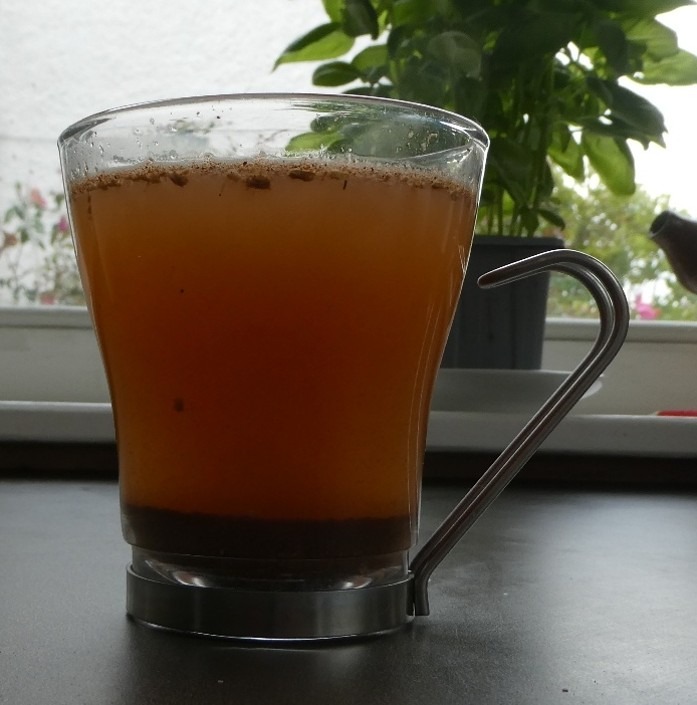
Here is a picture of my final herbal remedy – which tasted remarkably pleasant.
Herbalists who used the Powder in the cholera epidemic of 1853 in Newcastle-upon-Tyne
On 2 September 1853, the General Board of Health were informed of a case of cholera in Newcastle. Cases peaked on 16 September and over 15,000 people died out of a population of 90,000 in nine weeks. The government report can be summarised as “many sanitary defects simultaneously exhibited” (Hume et al., 1854; Robinson, 1853).
In late 1852, Skelton had given a course of twelve lectures in Newcastle. In 1853, the Medico-Botanic Society of Newcastle met weekly and, as soon as they were alerted to the risk of cholera, they sent off to Skelton’s wholesale business in Leeds for the Anti-Cholera Powder. Skelton had two agents in Newcastle who sold his herbal products and reference books. They were the Dispenser for the Society, William Sewell of High Bridge and David Imrie of Hanover Street (Botanic Record 10, February 1853, p. 160).
Several letters from Newcastle were printed in the Medical Society’s journal including one from David Imrie which stated that ‘Seventy cases have already come under my care, many of them most dreadful. I can assure you my nerves were shook pretty severely at first, but they are right now, and I don’t fear the disease in its worse form.’ (Botanic Record 18, October 1853, p. 276).
Other non-professional members of the Society used herbal medicines for their family. One letter gave a personal account of using the Cholera Powders and other herbs in Gateshead on 5 September 1853 (Botanic Record 19, November 1853, p. 303).
“it came on with a heavy trembling …as fast as taken I vomited them again, until the spasms and pains with cramp in the feet got to such a pitch, that I thought I should have died….I took a whole ounce of the anti-cholera powder, and after that commenced taking tormentil boiled in water, then added a little new milk, and continued taking it until the purging ceased.”
Skelton was always eager to point out that the herbs can be effective even if the people using them have little education or medical knowledge.
My recreation of Anti-Cholera Powder
Method
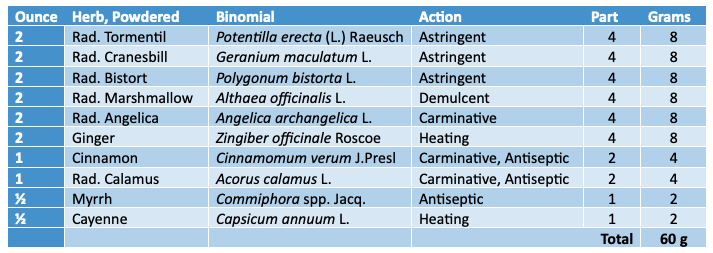
- Copy out the prescription as above from the left, in columns: units as given; herb as given
- Change the units of weight into parts: so, take the smallest amount – in this case ½ ounce of Myrrh, and take that as one part
- Give the number of parts for each herb
- At this point, decide how much to make: I made one part = 2 g. This is the most important step as it means that you will always keep the same proportions and thus the correct dosage
- Add in the Latin binomials for each herb. This stage can be difficult, especially if the common or Latin names used at the time have changed.
- Make any substitutions:
- Are there any toxic herbs? If so, either substitute or increase another herb, so that the proportions remain the same.
- Can you obtain all the herbs? For example, it would have been more practical to double the astringent Potentilla erecta (L.) Raeusch, as a substitute for the astringent Geranium maculatum L.
Powders: wear a mask. Powdered herbs all look much the same, so organise them in a row on the work surface, tick them off the list in order and label immediately.
How to use it?
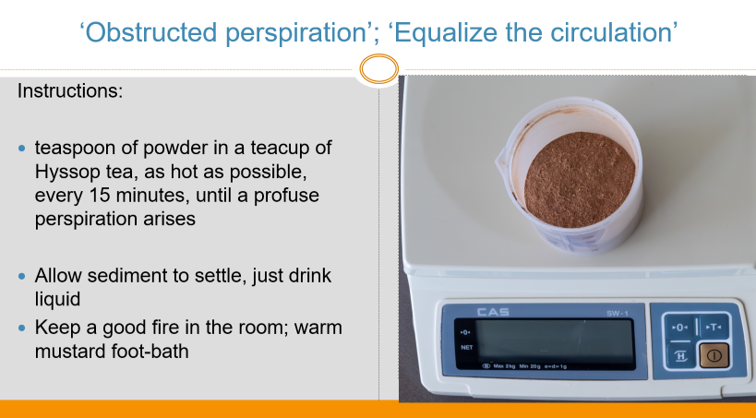
To use any prescription from the past, you need to understand more about the treatment rationale – in this case, to keep the patient warm and keep the circulation moving. Skelton set this out in the Family Medical Adviser (1852) with his instructions for use of the Anti-Cholera Powder and explained his rationale for treatment of cholera, diarrhoea and vomiting and dysentery. In his 1866 pamphlet (available online), Skelton discusses both his views on the treatment of cholera and gives instructions for usage.
Conclusion
Recreating prescriptions is a surprisingly challenging and time-consuming process. However, prescriptions are a window into lost knowledge and a so-called tradition needs constant thought and renovation.
When I qualified as a herbal practitioner in 1984, the NIMH training course was throwing off the past and modernising the curriculum, but one of my co-students was Morag Weatherstone (1946-2021). Morag trained with Louise and Wilfred Morley in Doncaster, South Yorkshire. When they retired in the 1980s Morag took over the practice and was an inspiration to me as she was the custodian of a thread which went back to something much older as Wilfred Morley had inherited the practice from his grandfather.
A finding from my research is the startling loss of knowledge since the 18th century. To end with a quotation from Skelton (Plea, 1853, pp. 56-57) who argued that botanic medicine was swept aside because “the old Galenists were asleep in the fancied seclusion of the schools and the cloister, secure in the arms of settled faith and dignified self-consciousness.” He continued, “nor is it possible to contemplate the total wreck of the immense fabric of botanic knowledge, and calculate upon the world’s loss in consequence, without feeling that in the sacrifice there is much over which the philanthropist must mourn.”
References
(Botanic Record) Dr. Skelton’s Botanic Record and Family Herbal. Leeds: S. Moxon, 1855.
Broom, W. W., (1853). Many botanical secrets!! The prescription of the anti-cholera powder. Halifax: W.W. Broom. [online] Available at: https://www.google.co.uk/books/edition/Many_Botanical_Secrets_The_prescription/rBhbAAAAcAAJ?hl=en&gbpv=1&dq=many+botanical+secrets&pg=PA5&printsec=frontcover [Accessed 30 July 2026].
Chowdhury, F., Ross, A., Islam, T., et al., (2022). Diagnosis, management, and future control of cholera. Clinical Microbiology Reviews, 35(3), e0021121. https://doi.org/10.1128/cmr.00211-21
Hume, J.B. et al., (1854). Report of the commissioners appointed to inquire into the causes which have led to, or have aggravated the late outbreak of cholera in the towns of Newcastle-upon-Tyne, Gateshead, and Tynemouth. London: HMSO. [online] Available at: https://wellcomecollection.org/works/rsgsdvt4 [Accessed 30 July 2026].
Robinson, G., (1853). Appearance of cholera in Newcastle. The Lancet 62 (1567), 10 Sept, p.254.
Romola, J. D., Satchell, M. & Shaw-Taylor, L., (2019). Cholera as a “Sanitary Test” of British cities, 1831–1866, History of the Family, 24(2), 404–438. doi:10.1080/1081602X.2018.1525755.
Skelton, J., (1852). Family medical adviser. Leeds: Moxon and Walker. [online] Available at: https://www.google.co.uk/books/edition/Family_Medical_Adviser/qxsDAAAAQAAJ?hl=en&gbpv=1&dq=family+medical+adviser&printsec=frontcover [Accessed 30 July 2026].
Skelton, J., (1853). An examination of the pathology of cholera, revelations of past and present modes of treatment, thermobotanic method of cure. London: J. Watson.
Skelton, J., (1853). A plea for the botanic practice of medicine. London: J. Watson, [online] Available at: https://wellcomecollection.org/works/djdt398n [Accessed 30 July 2026].
Skelton, J., (1866). Cholera: its past and present treatment, and natural method of cure. London: Job Caudwell. [online] Available at: https://www.google.co.uk/books/edition/Cholera_its_past_and_present_treatment_a/5PdZAAAAcAAJ?hl=en&gbpv=1&dq=john+skelton+cholera&printsec=frontcover [Accessed 30 July 2026].
Further Reading
Wikipedia page on John Skelton, authored by Alison: https://en.wikipedia.org/wiki/John_Skelton_(herbalist)
Four chapters in Tobyn, G., Denham, A., & Whitelegg, M. (2011). The western herbal tradition: 2000 years of medicinal plant knowledge, Reprint 2016. London: Singing Dragon.
- 19th century herbal medicine,
- Marshmallow,
- Tormentil,
- Weights and measures.
Biography
Alison is a Fellow of the National Institute of Medical Herbalists and taught on the BSc Herbal Medicine and then the e-learning MSc programmes in Herbal Medicine and Integrated Healthcare at the University of Lancashire from 2000 until 2016.
Her current research is on the publications of Dr John Skelton (1805-1880) who was a leading Chartist and later a prominent herbal practitioner.
A list of Alison’s publications can be found on her Google Scholar profile.