Scandinavian culture is intrinsically connected to its flora. This might be true of all societies and communities, but it rings especially true in the northernmost parts of Europe, where the love of nature is reflected in bank holidays and festivals. Midsommar, one of the best-known Scandinavian festivals of the modern era, most common in Sweden but also prevalent in Norway and Denmark, embodies the idea of the community becoming one with nature, as maypoles and flower crowns made of birch and flowers are assembled. It is a time of celebrating the coming to life of all living creatures. Nevertheless, as time passes and the flowers wilt, it is a reminder of the ephemerality of life; flowers are a symbol of the balance between life and death.
These ideas and customs that take place in the threshold between spring- and summertime are believed to be rooted in an older, pagan fertility cult. This is certainly possible, though the origins of the Midsummer festival are obscure. There is, however, another pagan fertility ritual from the Middle Ages that is a far cry from the glamourous flower crowns and dancing in circles – rather than birch and pretty flowers, the favoured seedling to represent fertility was a plant by the name of laukr. Speakers of modern Scandinavian languages might recognise this as ‘onion’ (Allium cepa L.), with laukr, løk, løg, or lök amongst its spellings. Other types of alliums are usually preceded by a prefix (in Danish) such as purløg (‘leek’, Allium ampeloprasum L.), rødløg (‘red onion’, Allium cepa L.), and hvidløg (‘garlic’, Allium sativum L.).
Alliums in Medieval Herbals
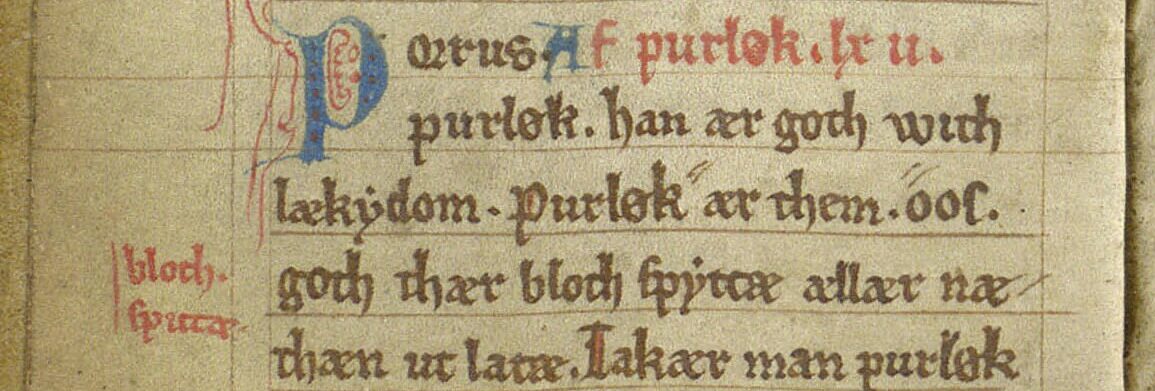
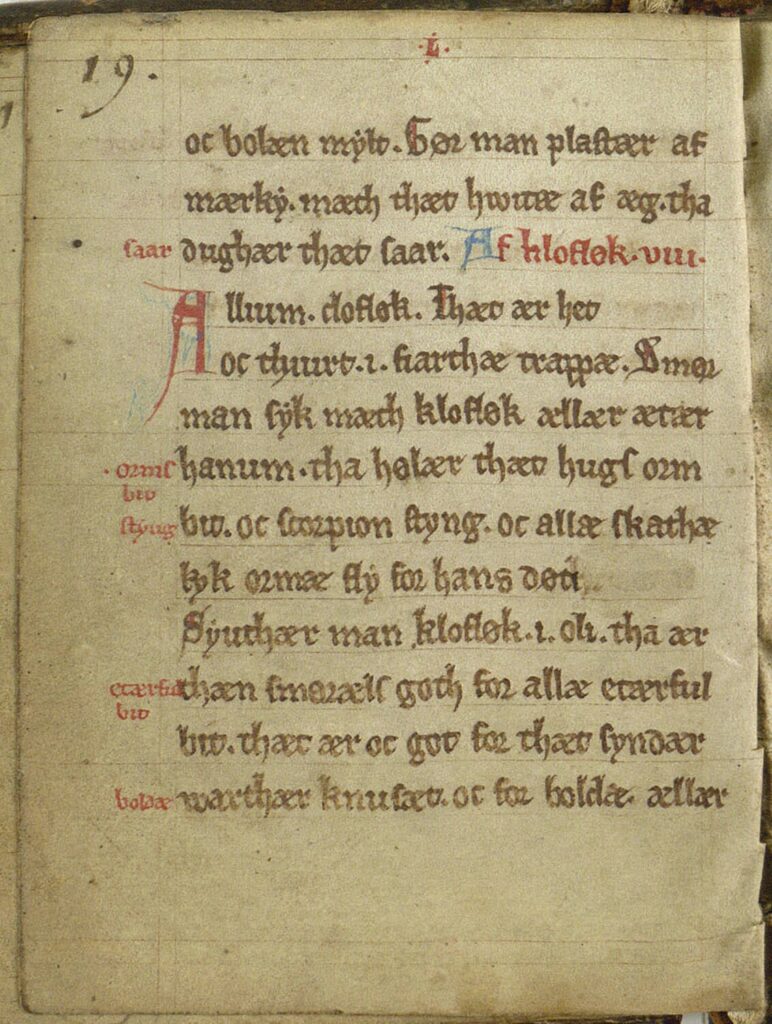
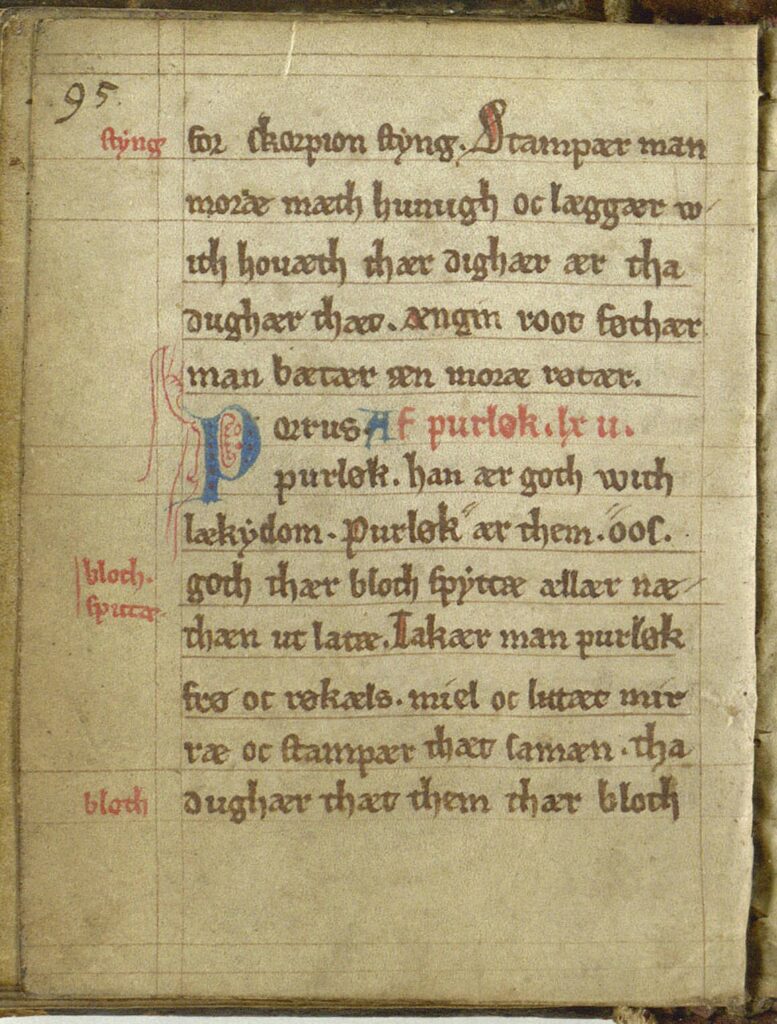
It is most likely that by laukr, medieval Scandinavians referred to any type of species within that genus, though it is often translated as ‘leek’ by English speakers. Our biggest reference for medieval botany in Scandinavia is the Danske Urtebog (the Danish Herb Book) by Danish physician Henrik Harpestræng. This botanical work dates from the turn of the thirteenth century, and though the original manuscript has been lost, it has been preserved in various manuscripts from later periods; the earliest dating to the turn of the fourteenth century: K 48, now housed in Stockholm, and NKS 66 (Figures 1 & 2), in Copenhagen. The herb book encloses entries on 136 medical ingredients, 125 of which are plants or substances derived from plants, such as mastic or frankincense and three types of alliums are mentioned: kløfløk (‘garlic’), uniæn (‘onion’), and purløk (‘leek’). There is some overlap between the ailments that these species are said to cure: headaches, infections, pneumonia and other lung problems, abscesses, dog and snake bites. On the entry for purløk it is stated that leeks are one of the most valuable medicaments and, unlike its other two relatives, it also said to aid with fertility by ‘rinsing blood from the womb’ (presumably referring to women’s menstrual cycle, which is crucial for the conception of a child) as well as by working as an aphrodisiac for men, possibly due to its elongated shape resembling a phallus. This is a remnant of the Doctrine of Signatures, a theory that dates back to Antiquity where the physical attributes of plants were thought to reflect their medicinal value.
Alliums in Old Norse literature
This connection between alliums and fertility in Old Norse literature is best portrayed in the Vǫlsa þáttr (roughly translated as ‘the tale of Volsi’), a short story found in the fourteenth-century Icelandic manuscript known as Flateyjarbók. Set in 11th century Norway, the story portrays a family who had a horse butchered, wrapped its phallus in laukr and a cloth of linen, and then worshipped it every evening during the autumn as a ritual for an abundant harvest. It is unclear whether this outlandish story describes a genuine medieval practice or whether it was written as entertainment (or even both!). Whatever we choose to believe, it still highlights the importance of alliums as a symbol of fertility in the medieval Scandinavian mind, and it must be noted that it does not stand alone in the literary corpus.
In Vǫluspá, a poem that narrates the story of the creation of the world, the reader is told that when the god Óðinn and his brothers created the world, the ground var grund groin grænum lauki (‘was covered in green alliums’). This curious detail not only asserts alliums as a plant connected to the gods, but also alludes to its facility to grow and propagate. Similarly, in Flóamanna saga, a dream is described wherein five halmlaukar (or hjálmlaukr, ‘helmet alliums’) grow from a man’s knee that are then interpreted as representing his five children, this time acting as a symbol for human life too.
It is unclear what a ‘helmet leek’ is, but many literary texts mention (probably) fictional types of laukr, such as vínlaukr (‘wine-leek’, in Ragnars saga lóðbrókar), geirlaukr (‘spear-leek’ in Heiðreks saga), and ítrlaukr (‘noble-leek’, in Vǫlsungakviða). In other words, alliums are used as a literary device to highlight certain aspects of a story.
Alliums in Runic Inscriptions
We cannot speak of alliums, fertility, and magic in a Scandinavian context and not mention the runic formula on the fourth-century Norwegian Fløksand knife. The inscription reads linalaukaRa (‘linen, leek, a[le]’). It has been generally agreed that the inscription was a charm to aid the conception of a child: the linen representing womanhood, the allium representing virility and strength, and the ale, a powerful drink associated with Germanic rituals, adding an extra magical component. Other inscriptions, such as the one on the fifth-century Gjersvik knife invoke the power of the leek ten-fold. The inscription reads llllllllll: ten individual l-runes, which have been accepted to stand for laukr (Krause 1946, 219-20).
Bring Alliums Back!
Alliums were once the most popular plant in Scandinavia. From their use in food, medicine, and literary imagery, the whole genus was a symbol of fertility, birth, renewal, and health. So, as the year slowly comes to a close, and the warmth and light of the summer become a distant memory, let us forget the daisies and the birch and grab some alliums to celebrate the arrival of the harvest and embrace the winter the medieval Scandi way!
References
Heizmann, W., (1992). ‘Lein(en) und Lauch in der Inschrift von Fløksand und im Volsa þáttr’. In H. Beck et al. (Eds.). Germanische religionsgeschichte: Quellen und quellenprobleme.
Krause, W., (1946). ‘Untersuchungen zu den Runennamen. I: Die Lauch-Rune; II: Runennamen u. Götterwelt’, Nachrichten der Akademie der Wissenschaften zu Göttingen, 46/47.
Lange, J., ‘Løg-LaukaR. Studier over en ordgruppe i nordiske sprog’, Sprog og.
Kultur 23 (1964), 28-32.
Lehmann, W. P., (1955). ‘Lín and Laukr in the Edda’, The Germanic Review: Literature, Culture, Theory, 30(3).
Further Reading
Markey, T. L., (2013). ‘Garlic and Sapphires in the Mud: “Leeks” in their Early Folk Contexts’, Leeds Studies in English XLIV.
Mørkved, B., (1998). ‘Løk– våre eldste kulturplante?’, Ottar 220.
Saltveit, L., (1991). ‘Die Runenwörter laukaR und alu’, Festskrift til Ottar Grønvik på 75-årsdagen den 21. oktober 1991.
Biography
Lara E. C. Harris is a PhD student at the University of Cambridge, in the Department of Anglo-Saxon, Norse and Celtic. Her interests revolve around the History of Medicine, Ethnobotany, and how these disciplines relate to Women’s History. Her current research centres around herbal treatments for gynaecology and obstetrics in medieval Scandinavian manuscripts, up to the year 1550. She has previously worked on herbal runic inscriptions and published on the cryptic thistle-mistletoe formula, ‘Þistil, mistil, kistil: Plants of Death, Rebirth, and Magic in Medieval Scandinavian Runic Inscriptions’, Scandinavian Studies (2023) 95 (2): 133-165.