By Lai Yan Wong, PhD student in the Department of English at King’s College London.
‘Rhubarb, tea, silk are all valuable products of ours, without which foreigners could not live’ (Waley, 1958, p. 29), Commissioner Lin wrote in 1839, threatening to counter British opium trade with a rhubarb embargo. A belief in China at the time was that Westerners ‘have a predilection for dairy products, which cause intestinal blockages that can be relieved only with rhubarb and tea’ (Xiao Lingyu, 1821, cited in Chang, p. 351), revealing a strong opinion of Western dietary and medical habits.
Medicinal rhubarb (Linn. Rheum palmatum, Chinese 大黄 da huang) is a potent purgative, capable of both loosening and binding the bowels depending on dosage. In China, it was classed as a dangerous cathartic rather than a commonplace remedy; in Europe, however, it circulated as a more tempered medicine. It is therefore unsurprising that Chinese officials would attribute Europe’s demand for rhubarb to a fundamental issue with their diet.
Research into Chinese rhubarb is part of my wider project on representations of Chinese plants in eighteenth-century British literature. This article highlights some notable accounts of rhubarb, focusing on how it was understood within Chinese and European pharmacological traditions.
Brief medicinal rhubarb history
One of the earliest Western records of rhubarb was in Dioscorides’s De materia medica (50–70 CE) as Rha, said to treat ‘gaseousness, weakness of the stomach’ (2000, p. 364) (Figure 1). Marco Polo, in Il milione (c. 1300), noted that ‘rhubarb grows in the highest perfection’ in the province of ‘Sin-gui’ – modern Suzhou in China (1908, p. 289). Its uses and origins were further documented by Garcia de Orta in 1563: ‘the Chinese boiled or distilled the roots and used the water as a purge […] all the rhubarb that comes from Ormuz to India first comes from China’ (1913, p. 390).
Imported rhubarb was often named after its route: ‘Indian’, ‘Turkish’, ‘Crown’ (‘Russian’) rhubarb were all names for the presumed Rheum palmatum, the so-called ‘true rhubarb’. Other botanical varieties, such as the Rheum rhabarbarum now used for culinary purposes, further complicated attempts to source the medicinal kind. Clifford Foust’s Rhubarb: The wondrous drug (1992) provides a detailed account of the plant’s early history, situating its consolidation no earlier than the mid-nineteenth century.

Da huang in traditional Chinese medicine
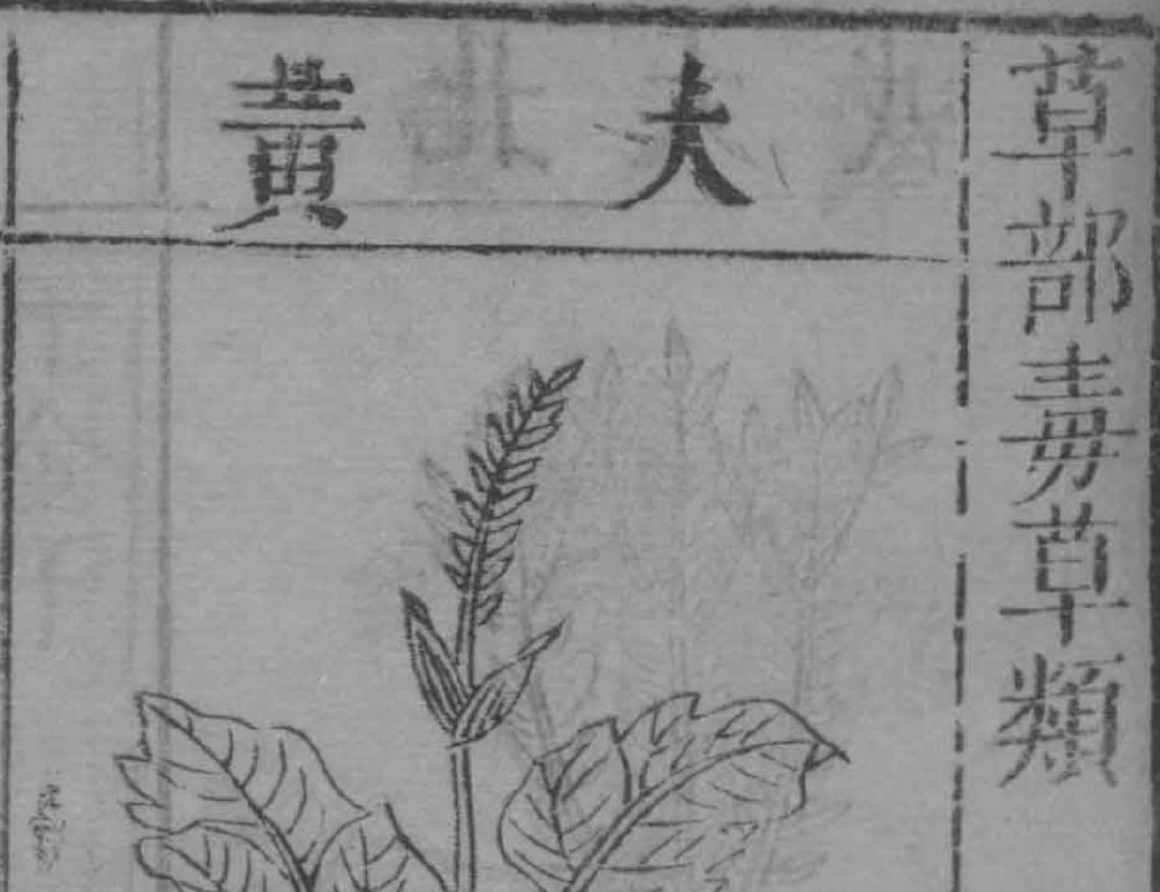
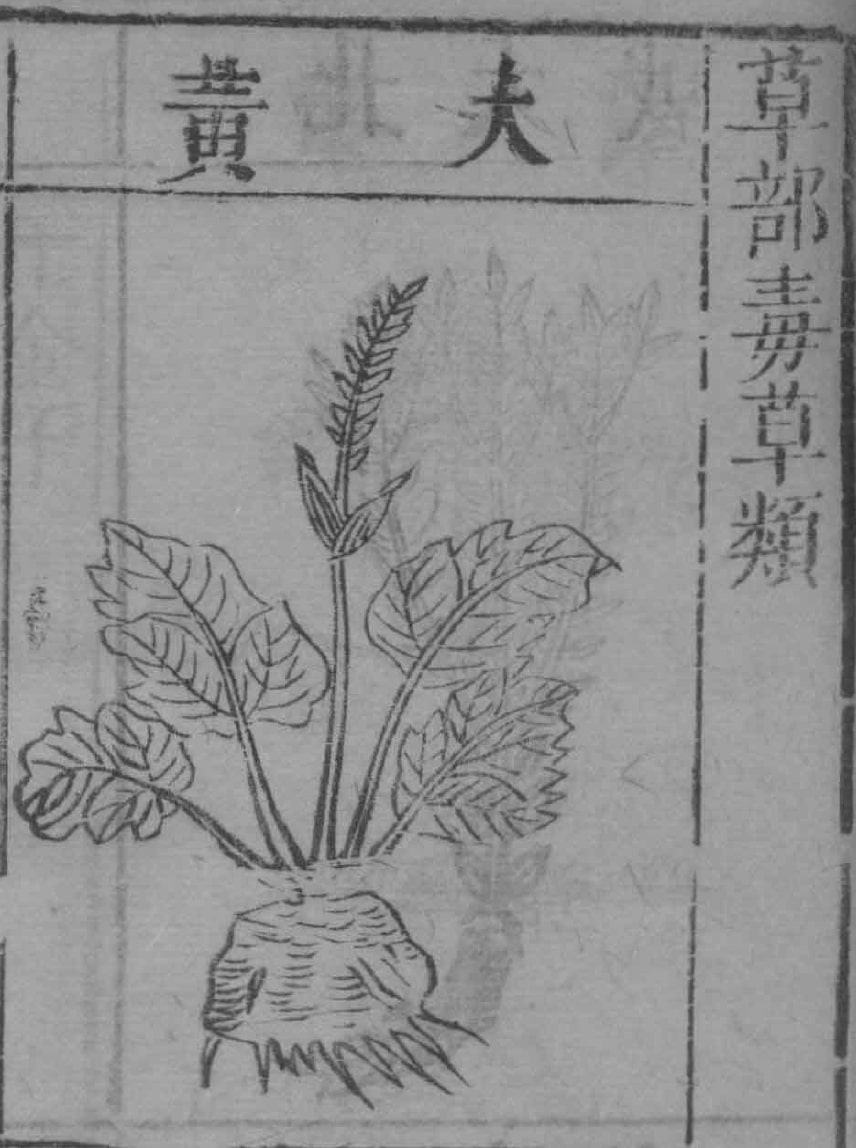
In Shennong bencao jing (25–220 CE), the oldest surviving Chinese materia medica, rhubarb was classified under ‘low herbs’ (下品) which included strong, often poisonous, substances. It was recorded to treat illnesses from malaria to jaundice, tackling especially the stomach and intestines and continues to be used in TCM for its efficacy in protecting the liver but only in small doses. Li Shizhen’s Bencao gangmu (c. 1596), also known as the Compendium of materia medica, described the rhubarb as holding the military rank of ‘General’ (將軍) for its potency (Figure 2). Methods of preparation differed according to prescription: for nosebleeds, rhubarb was boiled with other herbs and the liquid consumed; for lower-back pain, it was fried in ghee until dry, then pounded, sieved and taken on an empty stomach.
Rhubarb was not only ingested but also applied externally. Wang Tao’s Waitai miyaofang (752 CE), the Arcane essentials from the imperial library, recorded a ‘Nine-Substance Rhubarb Plaster’ (九物大黄薄贴) for treating carbuncles. Although versatile, rhubarb was viewed with caution: Zhang Jiebin’s Bencao zheng (1624) named rhubarb as one of the four cardinal drugs to be used only as a last resort. The very term bencao (materia medica) meaning ‘rooted in herbs’ reflects China’s extensive reliance on botanical medicines (Zhao et al., 2018).
Rheum in Western medicine
To Europeans, rhubarb’s appeal lay in its cleansing properties, which aligned neatly with humoral theory. The Dutch physician Herman Boerhaave (1668–1738) classed rhubarb as a gentle purgative, often prepared by soaking powdered rhubarb in ale (1741, pp. 204–06). The Scottish physician George Cheyne (1672–1743) recommended infusing rhubarb with wormwood, orange peel, nutmeg and cochineal in arrack – a luxurious and pungent spirit – to expel superfluous humours, taken by the spoonful (1724, p. 37).
The common Rheum rhaponticum and Rheum undulatum, otherwise known as ‘false rhubarb’ served as less potent substitutes before the introduction of the ‘true rhubarb’ to Britain in 1762 by James Mounsey. While medical–botanical writers such as John Parkinson (Theatrum botanicum, 1640) and Nicholas Culpeper (The English physician enlarged, 1653) believed that English rhubarb could rival the Chinese variety, others – including Joseph Pitton de Tournefort (Materia medica, 1708) and Philip Miller (Figures of the most beautiful, useful, and uncommon plants, 1760) – expressed doubts, noting that ‘there is yet great Doubt which of the Species now growing in the English Gardens is the true Rhubarb, or if either of them is so’ (Miller, 1760, p. 146).
Non-medical texts also recorded rhubarb. In The general history of China (1741), the French Jesuit historian Jean-Baptiste Du Halde described the Chinese method: rhubarb was ‘steep[ed] a Night and a Day in Rice-wine [Grape-wine would be better if they had it.] till they are well softened’, then steamed, dried and made into pills for swallowing (p. 229) (Figure 3). The difference in preparation is certainly interesting and highlight challenges in both cultural and botanical understanding. Boiled in water in China and steeped in alcohol in the West, the rhubarb changes with every interpretation. Its potency fades, too, with every effort to grow it beyond its original soil.

A rhubarb-specific publication appeared in Britain in 1792, when William Fordyce documented his method of cultivating the true rhubarb so people could ‘raise and prepare [it] for themselves’, reducing reliance on imports (p. 20). He recommended boiling rhubarb with Cream of Tartar and outlined different methods suited to both wealthy and poorer households. The plant gradually acquired a culinary identity alongside its established medicinal role through experiments with growing and eating the stalk of the common rhubarb, combined with the growing availability of sugar (Foust, p. 214). By the early nineteenth century, this sweetened stalk had become the familiar ‘garden rhubarb’ of British kitchens – marking the plant’s journey from purgative to pie.
References
Boerhaave, H. (1741). Materia medica: Or, a series of prescriptions adapted to the sections of his practical aphorisms concerning the knowledge and cure of diseases. London: Printed for W. Innys, at the West-End of St. Paul’s; and R. Manby, over-against the Old-Baily on Ludgate-Hill.
Chang, C-. C. (2005). ‘Origins of a misunderstanding: The Qianlong emperor’s embargo on rhubarb exports to Russia, the scenario and its consequences’, Asian Medicine, 1(2), pp. 335–354. Doi: 10.1163/157342105777996674.
Cheyne, G. (1724). An essay of health and long life. London: Printed for George Strahan, at the Golden Ball over-against the Royal Exchange in Cornhill.
Culpeper, N. ([1653] 1799). The English physician enlarged: with three hundred and sixty nine medicines, made of English herbs… London: Printed for W. Baynes.
Dioscorides, P. (2000). De materia medica: Being an herbal with many other medicinal materials written in Greek in the first century of the common era. Edited and translated by T. A. Osbaldeston. Johannesburg: Ibidis.
De Tournefort, J. P. (1708). Materia medica; or, a description of simple medicines generally us’d in physick. London: Printed by J. H. for A. Bell.
Du Halde, J-. B. (1741). A description of the empire of China and Chinese-Tartary … Vol. II. London: Printed by Edward Cave, at St John’s Gate.
Fordyce, W. (1792). The great importance and proper method of cultivating and curing rhubarb in Britain, for medicinal uses. London: Printed by T. Spilsbury and son, for T. Cadell.
Foust, C. (1992). Rhubarb: The wondrous drug. Princeton: Princeton University Press.
Li, S-. Z. (1596). Bencao gangmu (本草綱目), juan 17. [online] Wikimedia Commons. Available at: https://tinyurl.com/55y3zvv9 [Accessed: 8 December 2025].
Miller, P. (1760). Figures of the most beautiful, useful, and uncommon plants described in the Gardeners Dictionary, … Vol. II. London: Printed for the Author; And Sold by John Rivington in St. Paul’s Church-Yard.
Orta, G. D. ([1563] 1913). Colloquies on the simples and drugs of India. London: Henry Sotheran and Co.
Parkinson, J. (1640). Theatrum botanicum: The theater of plants. or, an herball of a large extent. London, Printed by Tho. Cotes.
Polo, M. (1908). The travels of Marco Polo, the Venetian. Translated by J. Masefield. London: J.M. Dent.
The Divine Farmer’s Materia Medica: A translation of the Shen Nong Ben Cao Jing (1998). Translated by S-. Z. Yang. Boulder: Blue Poppy Press.
Waley, A. (1958). The Opium War through Chinese eyes. Reprint 2005. London: Routledge.
Wang, T. (752). Waitai miyaofang (外臺秘要方), juan 24. [online] Wikisource. Available at: https://tinyurl.com/zv75xp3u [Accessed: 8 December 2025].
Zhang, J. (1624). Bencao zheng. [online]. WikiAvailable at: https://zh.wikisource.org/wiki/%E6%9C%AC%E8%8D%89%E6%AD%A3 [Accessed: 8 December 2025].
Zhao, Z., Guo, P. and Brand, E. (2018). ‘A concise classification of bencao (materia medica)’, Chinese Medicine, 13(18). Doi: 10.1186/s13020-018-0176-y.
As a general resource on Western conceptions of Chinese healing: Barnes, L. L. (2005). Needles, herbs, gods, and ghosts: China, healing, and the West to 1848. Harvard University Press. Available at: http://www.jstor.org/stable/j.ctv1pncpdt
Biography
Lai Yan Wong is a LAHP-funded PhD student in the Department of English at King’s College London. Her thesis examines the textual and visual representations of Chinese plants in eighteenth-century Britain. Her research interests include eighteenth-century literature, material culture, plant humanities and cross-cultural studies.
Email: lai_yan.wong [at] kcl.ac.uk