
By Dr Kim Walker, Royal Botanic Gardens Kew & Royal Holloway, University of London.
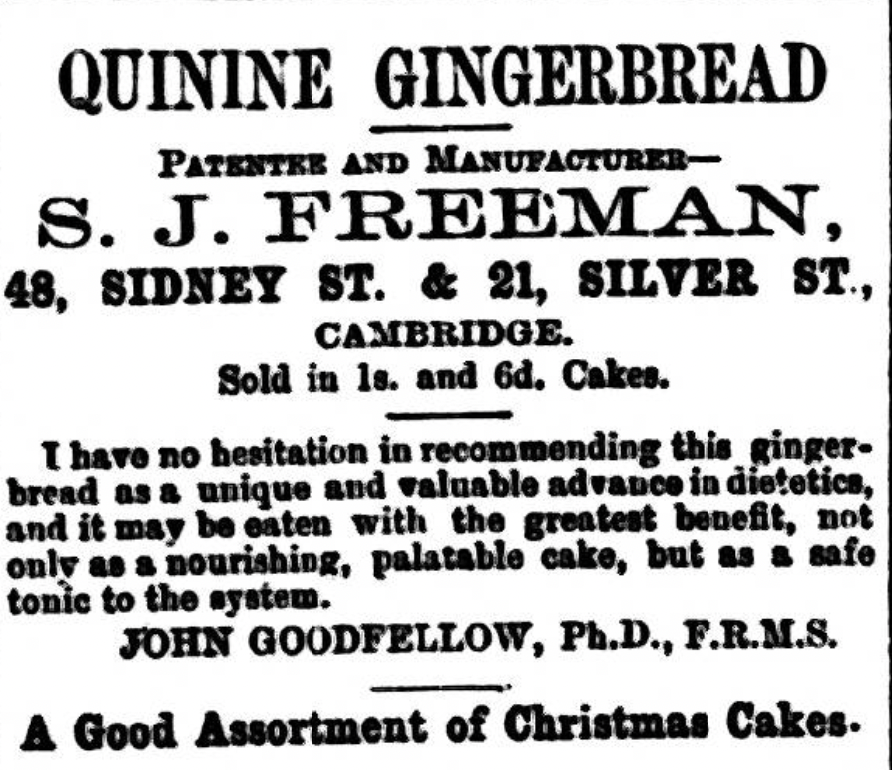
During October – December of 1895, adverts for a seasonal-sounding ‘Quinine Gingerbread’ were printed (Figure 1). This patented recipe was launched by Cambridge-based S. J. Freeman at the International Bakers and Confectioners Exhibition in London where it was reported as one of the ‘greatest novelties of the year’ and that ‘it is a pity this confection was not introduced 40 years ago’ (‘A new use for quinine’, 1895, p. 4).
Despite its launch at an international event, the gingerbread appears to have remained regionally advertised where it was promoted as a nourishing tonic (‘Quinine gingerbread’, 1895). Tonics were a popular category of medicine used to ‘tone’ bodily systems and reinvigorate the patient in conditions of debility, general or chronic inflammation or where “pathology is very obscure” (Pereira, 1854, p. 214; Fothergill, 1881). The action was, and still is, little understood as exemplified by one nineteenth-century doctor writing “We are very little wiser as to the modus operandi of tonics than Galen was” (Fothergill, 1881, p.24).
Tonics still hold an important place within many traditional medicine modalities, including Western Herbal Medicine (Götti et al., 2014). They were also once an important treatment as part of European orthodox medicine until the early twentieth century when whole plant drugs were gradually replaced with synthetic, single-compound medicines (Houghton, 2021). Their use were also challenged by new physiological insights and the rise of Pasteur’s germ theory which altered the understanding of causes of disease. These, and other medical paradigm shifts, gradually replaced Galenic theories of medicine of balancing the humours within a patient’s body, which included the use of tonics (Bhikha & Glynn, 2017; Layne, 2021).
Plants with a bitter flavour could be considered tonics. The action of bitters on stimulating digestive secretions in the gastrointestinal tract, to help break down food and increase absorption, is one way in which bitters are thought to work. This may be how they contribute to the tonic properties of rebuilding and nourishing the body (Pereira, 1854; Götti et al., 2014). Quinine gingerbread exemplifies the blurred boundary of tonics sitting between food and medicine, whereby they could be considered a nutritive convalescent medicine or to build up the body after periods of physical or mental stress (Pereira, 1854).
There is no evidence of how much quinine was contained in the gingerbread recipe, nor any guidance on how much someone was to take. Freeman was a baker who appears to have been capitalising on quinine’s place as a contemporary ‘darling’ pharmaceutical ingredient. Similar situations can be seen today in the way that some health food brands take advantage of trendy ingredients to market foods, for example, mushrooms, CBD (Cannabis spp.), maca (Lepidium meyenii), goji (Lycium spp.) and other high-value products. These types of ingredients are often categorised as ‘nutraceutical’ or ‘functional foods’, advertised to contain properties that enhance user health beyond their basic nutritional values. However, there is neither legal definition for these nor regulation leaving an open market ripe for exploitative marketing claims (Aronson, 2016; Williamson et al. 2019).
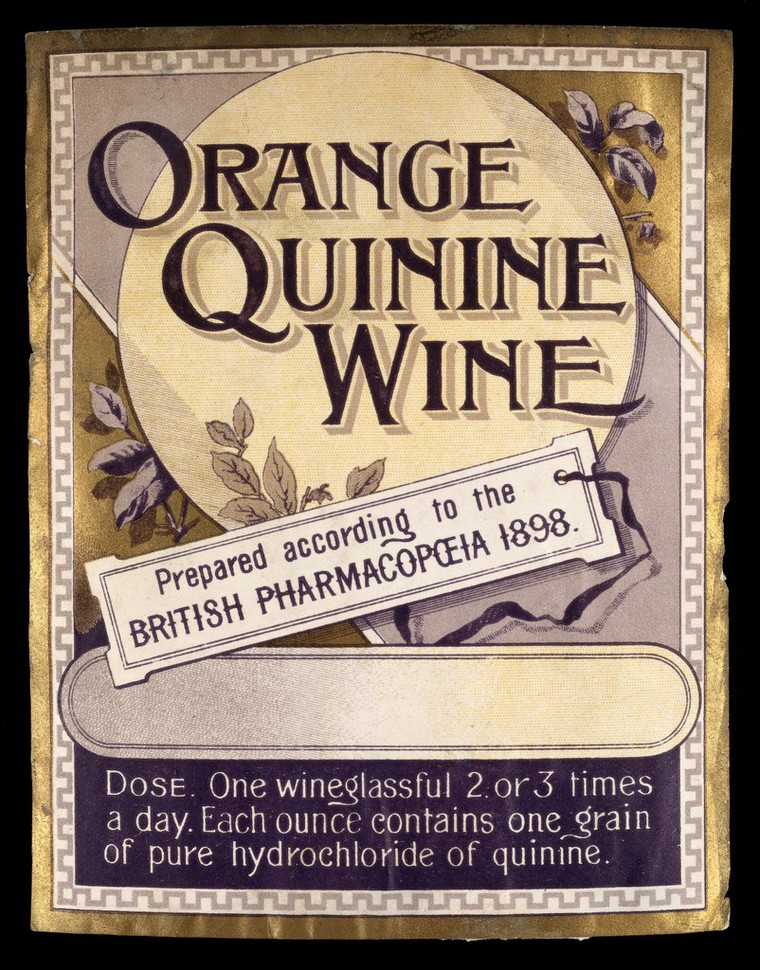
Extracted from the bark of the Andean fever tree (Cinchona spp.), quinine was primarily valued as an efficacious anti-malarial (Yarnell & Abascal, 2004). Due to its bitter-tonic properties, however, it became a popular ingredient of many Victorian over-the-counter tonic wines (Figure 2), often combined with other plant-based stimulants such as coffee / caffeine (Caffea spp.), coca / cocaine (Erythroxylum spp.) and chocolate / theobromine (Theobroma cacao) (Parssinen, 1983; Walker & Nesbitt, 2019). The invention of ‘tonic water’ in 1858 by Erasmus Bond of Islington, London, combined the well-known tonic properties of both quinine and soda water and was marketed as a digestive and general tonic. Many do not realise the popular pre-dinner ritual of a ‘Gin and Tonic’ originated due to association with these bitter-digestive properties (Walker & Nesbitt, 2019).
In relation to the flavour of Freeman’s gingerbread recipe, however, quinine’s bitterness was not an issue. Dr John Goodfellow PhD, Professor at the Bow and Bromley Institute of Science, endorsed the recipe as the official analyst at the Bakers Exhibition. In one letter to the Cambridge Chronicle and Journal, he described it as a ‘valuable advance in dietetics’ and that the ‘bitter taste was entirely masked and could not be detected in the slightest degree’ (Goodfellow, 1895a, p. 4). A rare appearance outside of Cambridge came in the pages of an Irish newspaper, the Northern Whig, where in its ‘Ladies Letter’, it further recommended the cake for indigestion and neuralgia, calling it a ‘very agreeable sort of medicine’ (Ladies’ letter, 1895).
However, despite its glowing recommendations, quinine gingerbread appears to have been a short-lived fancy, and did not become more widely known, nor did it incite any interest in the pages of the Pharmaceutical Journal. Nearly 130 years later, the texture and flavour of this intriguing recipe can only be left to the imagination. This holiday season, why not pair a slice of spiced gingerbread with a quinine-containing tonic water (gin optional) and give a nod to this fleeting, pharmaceutically-inspired seasonal confection?
References
A new use for quinine, (1895, October 4). Cambridge Chronicle and Journal. https://www.britishnewspaperarchive.co.uk/viewer/bl/0000421/18951004/091/0004
Bhikha, R., & Glynn, J. (2017). The theory of humours revisited. International Journal of Development Research, 7(9), 15029-34.
Fothergill, J. M. (1881). Aids to Rational Therapeutics. Specially Designed for Students Preparing for Examination. Baillière, Tindall & Cox.
Goodfellow, J. (1895, December 6). Report on the quinine gingerbread manufactured by S.F. Freeman. Cambridge Chronicle and Journal. https://www.britishnewspaperarchive.co.uk/viewer/bl/0000421/18951206/109/0004
Götti, R. P., Melzer, J., & Saller, R. (2014). An approach to the concept of tonic: suggested definitions and historical aspects. Forschende Komplementärmedizin/Research in Complementary Medicine, 21(6), 413-417.
Houghton, J. (2021). Making plants modern: Medicinal plants in twentieth-century British pharmacy. [PhD dissertation, University of Manchester].
Ladies’ letter. (1895, October 2). Northern Whig. https://www.britishnewspaperarchive.co.uk/viewer/bl/0000434/18951002/177/0008
Layne, L. (2021, March 16). Where did Galen go? Herbal History Research Network.
Parssinen, T. M. (1983). Secret passions, secret remedies: Narcotic drugs in British society, 1820-1930. Manchester University Press.
Pereira, J. (1854). The elements of materia medica and therapeutics (Vol. 1.). Longman, Brown, Green, and Longman.
Quinine gingerbread. (1895, December 20). Cambridge Chronicle and Journal. https://www.britishnewspaperarchive.co.uk/viewer/bl/0000421/18951220/078/0004
Walker, K., & Nesbitt, M. (2019). Just the tonic: A natural history of tonic water. Kew publishing.
Williamson, E. M., Liu, X., & Izzo, A. A. (2020). Trends in use, pharmacology, and clinical applications of emerging herbal nutraceuticals. British Journal of Pharmacology, 177(6), 1227-1240.
Yarnell, E., & Abascal, K. (2004). Botanical treatment and prevention of malaria: Part 2—selected botanicals. Alternative & Complementary Therapies, 10(5), 277-284.
Biography
Dr Kim Walker gained a BSc (Hons) in Herbal Medicine at the University of Westminster, before going into research. She gained a PhD from the Royal Botanic Gardens, Kew and Royal Holloway in 2023 studying the nineteenth century development of quinine as a pharmaceutical drug. She now works on a project exploring the history and impacts of coca and cocaine. She runs foraging and medicine making workshops via www.handmadeapothecary.co.uk and is a teacher at Betonica School of Herbal Medicine www.betonica.co.uk.
Her website is www.kimwalkerresearch.co.uk